
Post Horns by Graves & Co., Winchester, New Hampshire

Graves and Company was the first US firm to produce wind instruments in quantity, starting the 1820s. They made only woodwind instruments until the arrival from England, brass instrument maker James Keat in 1837. This Bb post horn was made about 1845 and has three double piston valves. This sort of valve was popular in Germany and Eastern Europe in the very early years of valve brass instruments and continues to be used today with side action levers in the famous Vienna Horns.


What was known as a post horn in the US was directly copied from small trumpets made in Europe where one might have been called a "trompetino". They were often made with rotary valves in Europe, but all known examples made in the US have this valve mechanism with double piston valves known today as “Mainzer”. This style of very small bore valved instrument had a very short tenure in the US along side the keyed bugle and quickly died out due to the popularity of the larger and louder cornets and Saxhorns which were introduced at about this time. A Graves alto with the same mechanism can be seen elsewhere on this site.
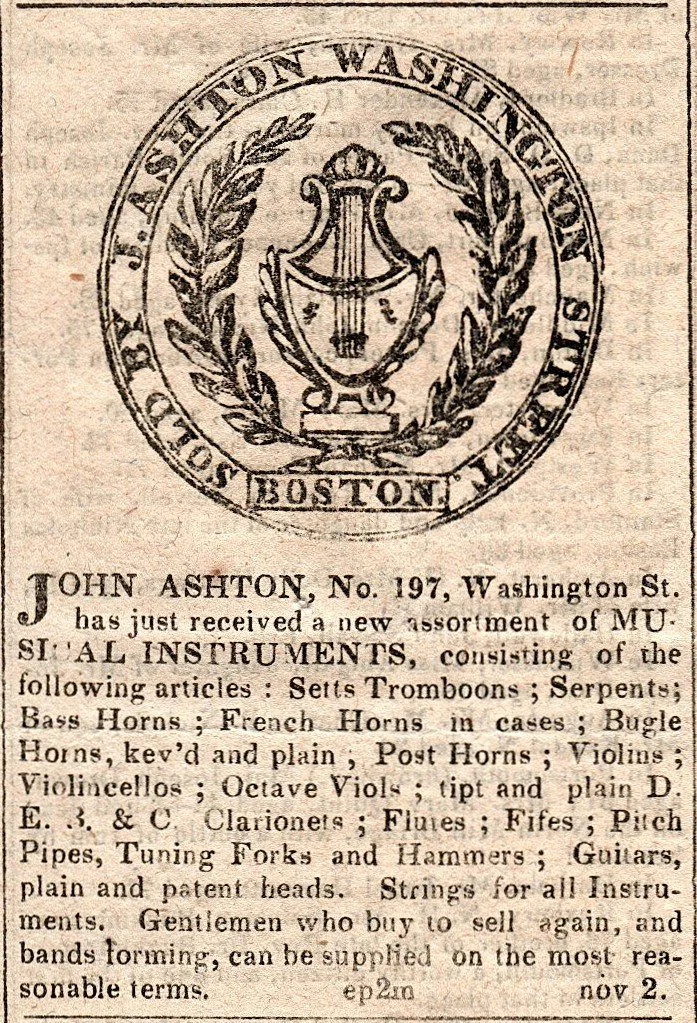
The origin of the use of the name “posthorn” for this small trumpet in American English is unknown. It could have come from either British or Germanic idioms, but resembles neither of those traditions. The earliest mention of post horns by an importer/dealer in the US is in 1827 by John Ashton in Boston. Another early example is in 1834 by auctioneers Coolidge & Haskell, also in Boston. Both of these ads are displayed below. It’s unlikely that a valved post horn as we are discussing here would be available in 1827, but possible by 1834. These could have been Germanic circular postal coach horns in F, which had been around for more than a century. Newspaper reports of an attempted robbery of a postal coach in Greensburgh, Pennsylvania, November 22, 1822, describes the ball from a pistol “went through the post-horn, which hung on the post at his left hand”. This may conjure the image of the circular body of a Germanic post horn hanging on that post, but could have been the more familiar shape of a bugle from the time or any other instrument with leather or cord strap. Graves & Co. started making trumpet shaped post horns with double piston valves in Winchester, New Hampshire around 1840. Hopefully, future study will reveal more about this likely case of mistaken identity.
I have found very little documentation for how these little trumpets were used in the US, but the image below shows a portion of lithograph sheet music cover for “Warren Phalanx Quickstep, as performed for the first time by the Boston Brass Band on their trip to Salem July 18, 1838” that included the band. The first row appears to be two French horns, keyed bugle, over the shoulder trombone and ophicleide. The second row includes five more musicians, the first at least, holds a trumpet shaped instruments with the loop of tubing above the bell, as in these post horns. Of course this is conjecture, since the image is not photo-realistic. All five in that row may have had post horns, or not. At this early date, all the brass instruments were likely made in Europe, although keyed bugles, at the least, were being made in New England.


The only photo of a musician in the US holding a post horn that I know of is reproduced on page 103 of “The Music Men, an Illustrated History of Bands in America, 1800 to 1920” by Margaret Hindle Hazen and Robert M. Hazen. This shows five brass players of the first band of Battle Creek, Michigan, about 1848. It consists of one each: alto and tenor Saxhorns, Sax style Bb cornet, Eb keyed bugle and Bb post horn.
There are only eight post horns in Bb, C and Eb by Graves known to have survived along with nine by other US makers. One of these was made by former Graves partner Samuel Richardson of Rochester, NY , one by Isaac Fiske, in Worcester, MA, four by E.G. Wright and three by J.L Allen in Boston. Two others were sold by J.A. Rohé in New York City, who had them made in Paris by Guichard or Gautrot.
This restoration was a challenge due to the extensive damage and deterioration of the metal. Numerous cracks had already been soldered over and needed very careful repairs. The result of the restoration is a highly collectible and very rare early American made instrument.


Interestingly, the only instruments that Graves engraved serial numbers on were those with double piston valves. This post horn was the earliest, with the number 84, until another, also in Bb, (surprisingly even rougher condition) surfaced more than 10 years later, with serial number 45 (last two photos). Notice that in this second post horn, the half step is in the first valve rather the the second as we are more accustomed. This was not unusual in very early valve brass instruments and most of the known post horns by Graves were made this way. While we don’t know the exact year that these instruments were made, Graves was advertising post horns for sale by 1842. Other US sellers (importers) list post horns as early as 1834, but I have no way of knowing if they were the same sort of instrument. As mentioned above, these had a very short tenure of popularity and it was valve cornet, already well known by 1841, that overtook the popularity of the keyed bugle by 1855 in brass bands and especially as the choice for soloists.


These post horns are 13” long, bell rim diameters are 4” and the bores measure .330”. Later examples of Graves post horns have slightly larger bores at .360”. The owner of the first example is Steven Ward.