
Brass Instruments by Joseph Anton Rohé and Henry Martin Leavitt

Joseph Rohe added the accent aigu over the “e” to make his German name seem French.
Joseph Anton Rohe was born in the city of Kleinwallstadt in the Kingdom of Bavaria on May 1, 1815 to an unmarried woman. Helmuth Lebert, a descendant, reported: “Because he was very intelligent and friendly, he got the chance to learn a merchant profession in Frankfurt. With money saved he went to Paris, but there is not much known about his activities in France.” We don’t know how long he lived in Paris, but he must have made important business contacts that would prove to be very valuable to his later activities. Presumably, this was also the time that he decided to add the accent aigu to his name, making it appear French.
Moving to the US, he first settled in Philadelphia and in 1838 and 1839 where he was listed in the city directories as an importer of music and instruments. It is unlikely that any of the instruments known are from this period. He was followed in 1840 by 23 year old Heinrich (Henry) Rohe, presumed brother, half brother or cousin. Henry settled in Cincinnati, listed in the 1850 census as a musician, but worked as a plumber. In 1840, Joseph Rohé’s business was listed on Maiden Lane in New York City, again in the music business and he stayed at this address until he retired in 1863. Timing was right and the business prospered, selling instruments and supplies imported from both France and Germany, both retail and wholesale. He applied for naturalization and became a citizen on November 4, 1846.
Rohé visited Europe at least six times between 1849 and 1874, sailing twice to Liverpool, England and four times to la Havre, which was the closest port to Paris. His family history states that he also traveled back to Kleinwallstadt during these trips, which is about 380 miles from Paris and the overland trip could have been made via Mainz, which is less than 50 miles east of Kleinwallstadt.
This cornopean (Stoelzel valve cornet) was restored for polymath (assuming that brass music is a math) Jeff Stockham in 2002. The work was extensive and required reproducing a number of missing parts based on an un-restored, but more complete example.


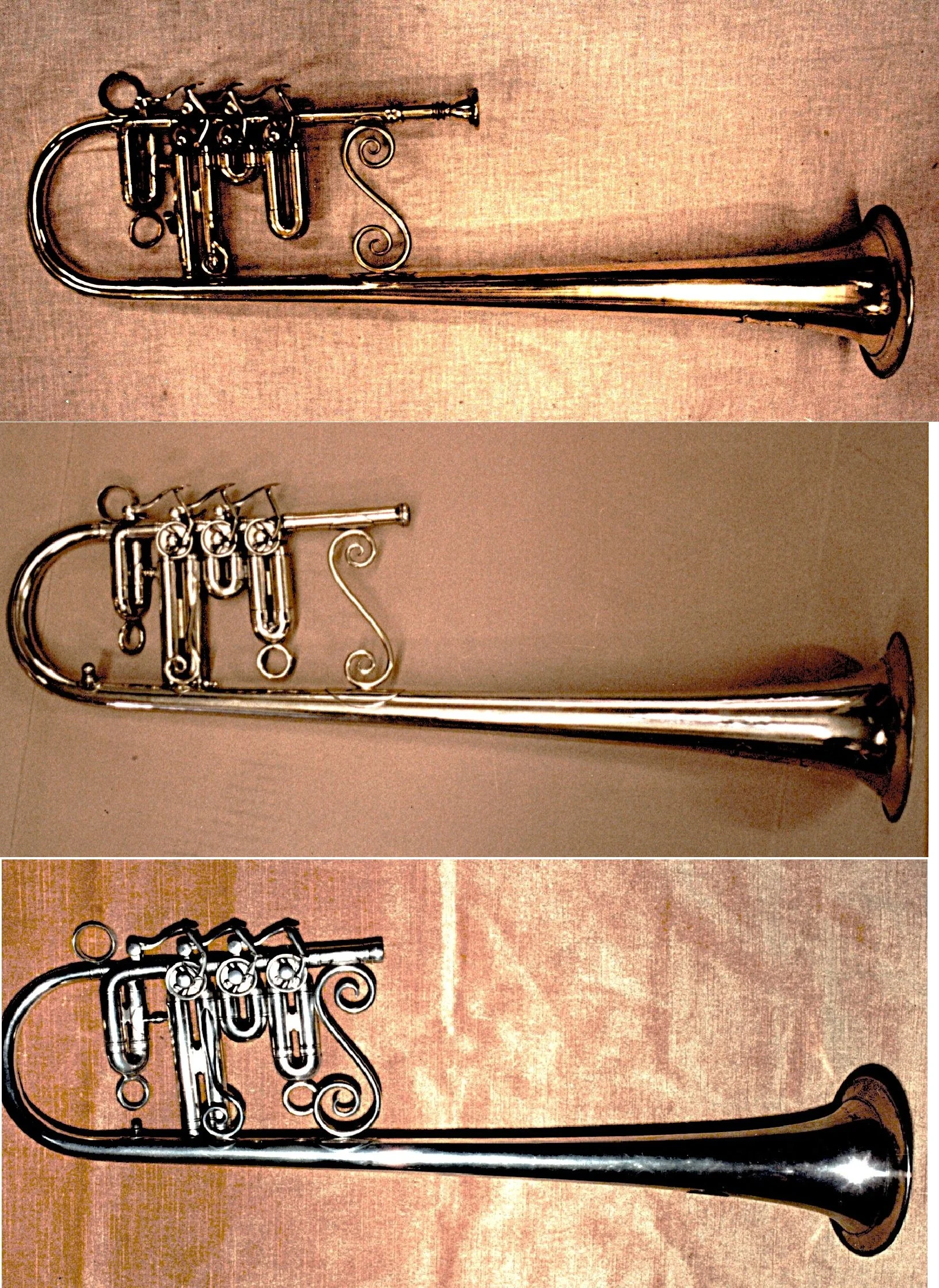
I'm revisiting this now, not so much that the restoration was interesting, but because an instrument by Rohé was the subject of an inquiry by Sabine Klaus recently. Sabine is studying the use of instruments with double piston valves (like those in a Vienna style horn) in the US and asked what I thought of the origins of a post horn (the name for a small trumpet in the US at the time and sometimes called "trompettino" in Europe) stamped "JA ROHÉ À PARIS", the same as this cornopean and a number of other brass instruments that all appear to date from before 1860. There are two of theses known to exist now, one owned by Vince DiMartino and another by Dan Rossi, pictured below.
I wasn't able to directly answer Sabine about the origins of the American post horn, but it isn't too much of a stretch to think that he may have had business dealings with instrument makers in Mainz and other German cities (see above for contrary evidence now in hand). The design of the valve mechanism in the "post horns" marked by Rohe and other US sellers and makers originated in Mainz and so is know to us today as "Mainzer machine". I also suggested that there may have been wholesalers in Paris or la Havre selling instruments made by makers throughout Europe. This would be another interesting angle to investigate, but we are now fairly confident that all of the instruments stamped "JA ROHÉ À PARIS” were made in Paris. I can finally answer Sabine’s question that these post horns with Mainzer machine valve mechanisms were almost certainly made in Paris, copying those made in Germany.
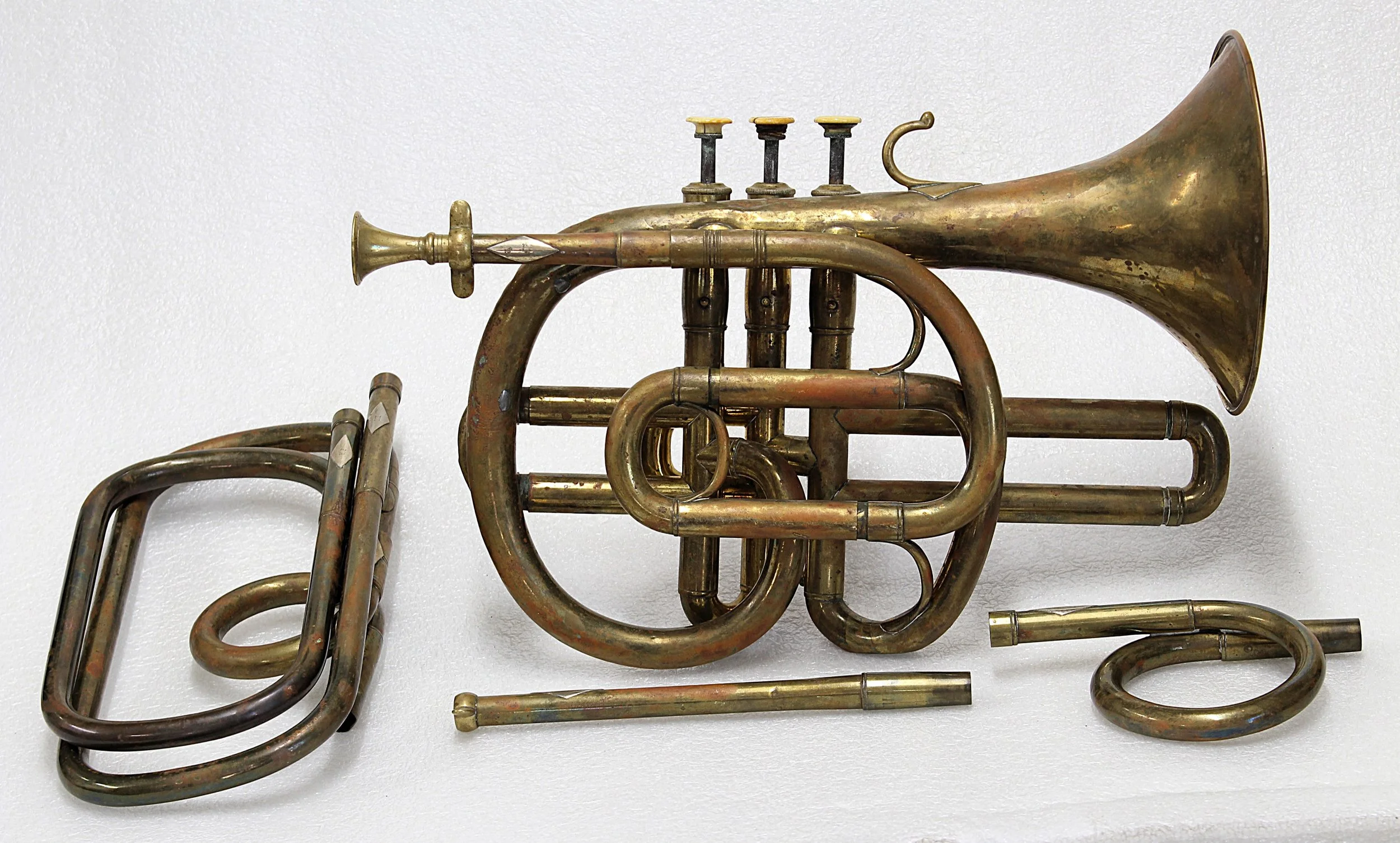

The most numerous of the instruments with Rohés name stamped on them are cornopeans like this one, but also include other early style instruments with Berliner piston valves. The cornopeans and Berliner valve instruments were most likely made by Gautrot (or Guichard before 1845) in Paris. The post horns are a style of small trumpet originated in Mainz, Germany before being used in the US and elsewhere. They were being imported in the US by 1834 and became popular enough that the New England makers started making them about 1840. The two instruments pictured above by Rohé in Dan Rossi’s collection, both very well preserved with original parts, indicate that they were from the same maker. At first look, the cornopean appears identical to the Stockham instrument, but a closer look reveals that the valve guides are external screws that extend through the ballusters, which also supports the internal spring. The later instruments (another example pictured below) have internal guides with two tabs, very much like the most common valve guides in trumpets and cornets today. The design was patented by Auguste Courtois, brother of the more famous Antoine Courtois, in 1847 for a period of 15 years. Gautrot may have paid license to Courtois for its use, since it is unlikely that these cornets were made after the expiration of the patent in 1862. Hopefully, more evidence will emerge in the future to indicate more accurately when these instruments were made, but it seems likely that the earlier examples were made in the 1840s, before Rohé teamed up with Leavitt.


Rohé’s instruments with Berliner valves are copies of instruments made by Adolphe Sax and were almost certainly made by Gautrot or Guichard as well. Photos below are a Sax-cornet, also in Jeff Stockham’s collection and Eb contrabass Saxhorn in Mark Elrod’s collection.


Also extant marked “J.A. Rohé a Paris” is a trombone with bell over the shoulder, another sort of instrument popular both in France and the US in the early 19th century.
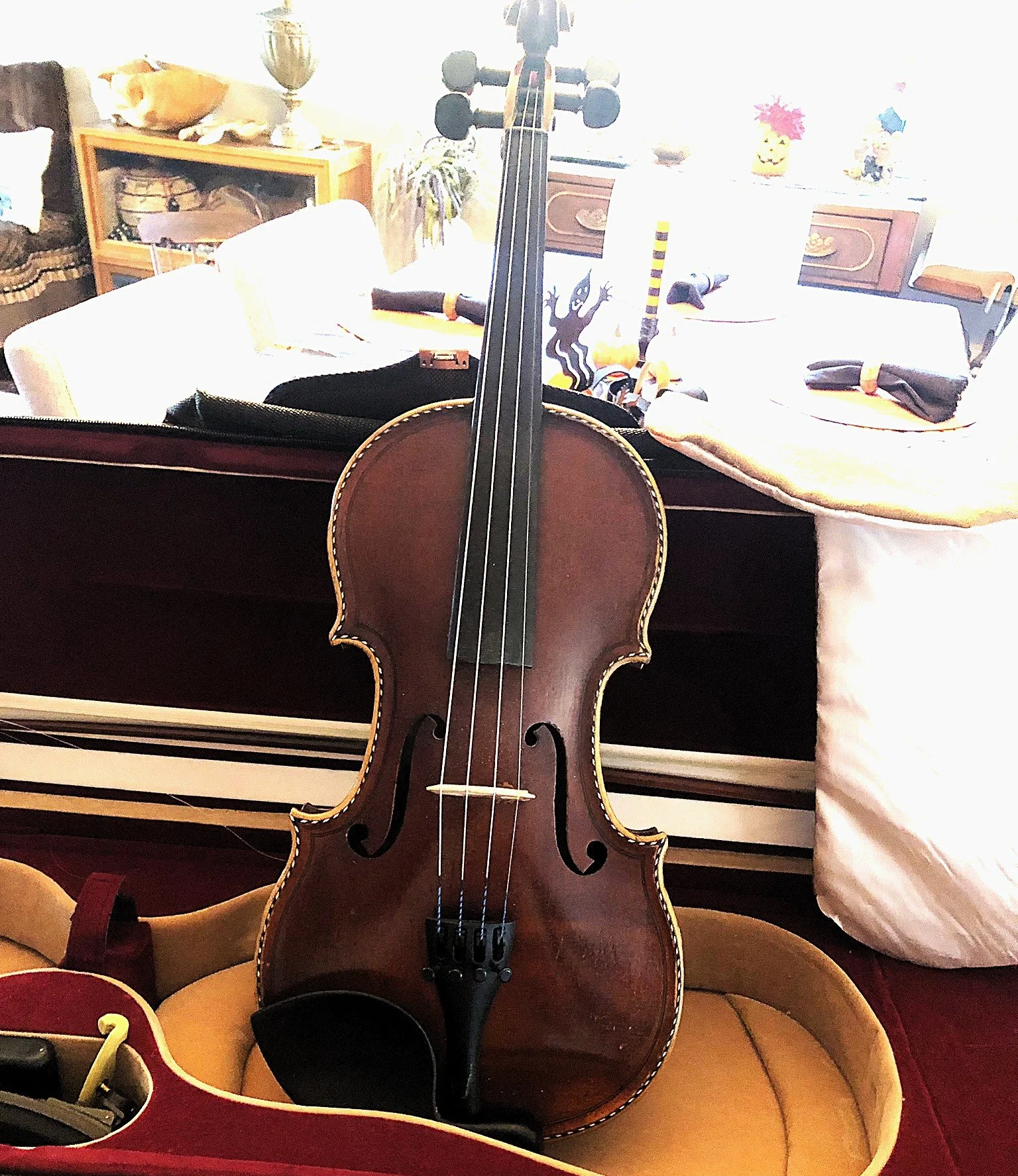
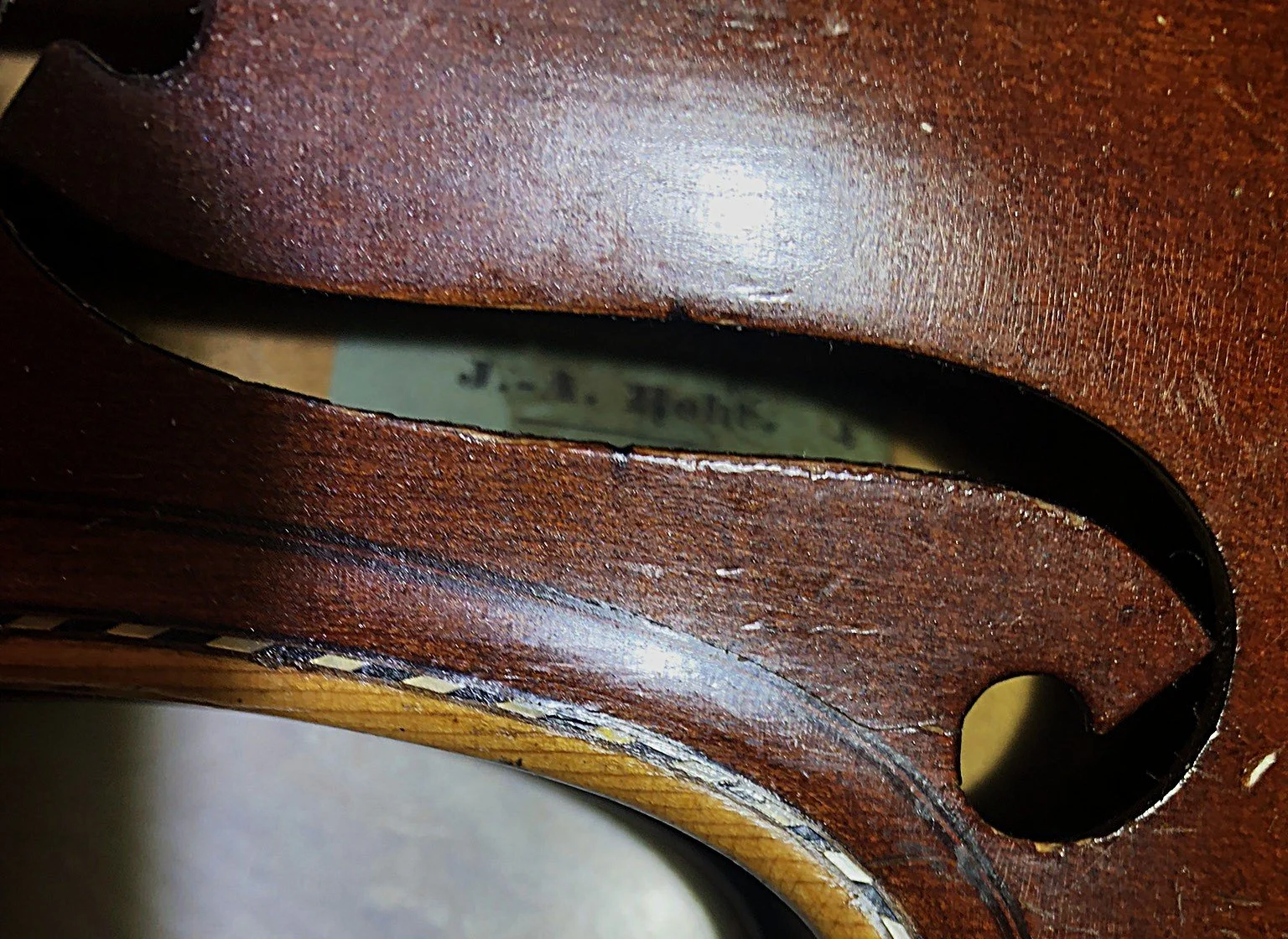
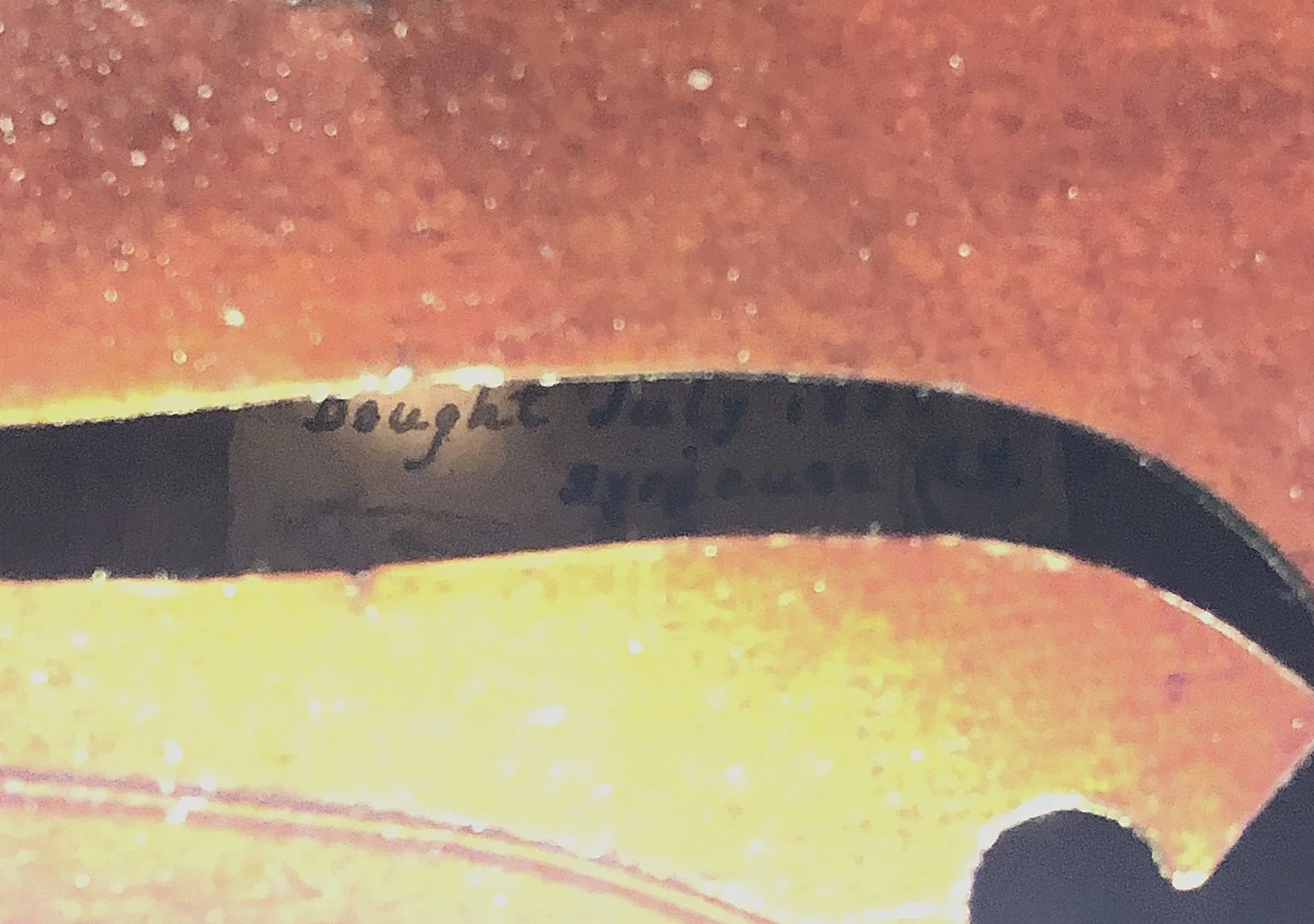
Susan Baxter, of Anchorage, Alaska, contacted me after reading this page. She has her grandfathers violin, pictured below. It has been in her family for over 150 years and she and her daughter play on it. It has two labels in it. Uppermost label reads: “Bought July 1851 / Syracuse, N.Y.”, the second: “J.A. Rohé (image of a small bird) / Maison d’instruments de musique en tous genres, fabriques / à Paris / J. A. Rohé”. This is probably the earliest instrument sold by Rohé where we know the date. There are many excellent violin experts that should be able to tell us more, such as whether this was made in France or Germany. Many excellent violins were made in both countries at that time.
In 1851, Rohé took on as partner Henry Martin Leavitt, just 21 years old at the time. Leavitt was born on February 20, 1830 and grew up in lower Manhattan, not far from Maiden Lane, where Rohé established his New York shop. He was named for Henry Martyn, a famous British missionary who had died in 1812. The Leavitt family had lived in New England for generations, but moved to New York to establish a publishing and book selling business in 1827. They were very successful, publishing geography textbooks and biographies of missionaries and other world travelers. According to the 1850 census, Henry was already a “Merchant” while still living with his parents. In March, 1855, he married Eliza Colt Winslow, born to British missionaries in Ceylon (present day Sri Lanka). She had been orphaned there, adopted and brought to New York by a fellow missionary. The 1860 census reported Henry’s estate as valued at $50,000, over $2,000,000 today. His residence in the Clifton neighborhood of Southfield, Long Island was on the same street as those of his stepmother and brother George, who continued in the book selling business.
In 1861, Eliza died, leaving Henry to raise three very young daughters, Josephine Antoinette, Mary Cooley and Margaret Robert (less than a year old). Of course, he also had five servants and his younger siblings Louisa and William living with him.
Click on images for larger views.


The ad pictured above indicates that they were also selling string and woodwind instruments from their music store. Rohé and Leavitt would have been interested in buying any instrument or other musical merchandise for which there was a demand in New York and during the 1850s. The demand was increasingly for the distinctly American style brass instruments with rotary valves. They sold instruments of this style under the name "Rohé and Leavitt" that were made in Germany. Based on the number of extant instruments marked by Rohé during his New York years, he must have been one of the most successful in the business of importing and selling brass instruments in the US. Also, by this time, ships crossing the Atlantic were becoming safer, faster and more frequent. Instruments made in large factories in Germany and France could be produced at a much lower cost than American makers. No price lists from Rohé and Leavitt have been found, but it is likely that they sold them at lower prices than domestic makers were able to.
Bob Eliason reports in volume 38 (2012) of the Journal of the American Musical Instrument Society in a very well researched article on the life and work of John Franklin Stratton, that John Howard Foote had worked for Rohé and Leavitt starting in 1857. Later court testimony states that Foote started working there in December of 1853. On July 1, 1863, Rohé and Leavitt dissolved their partnership, selling the entire business to a newly formed partnership between John F. Stratton and J. Howard Foote. Rohé and Leavitt were both then very wealthy retirees. There is no indication that either worked again.

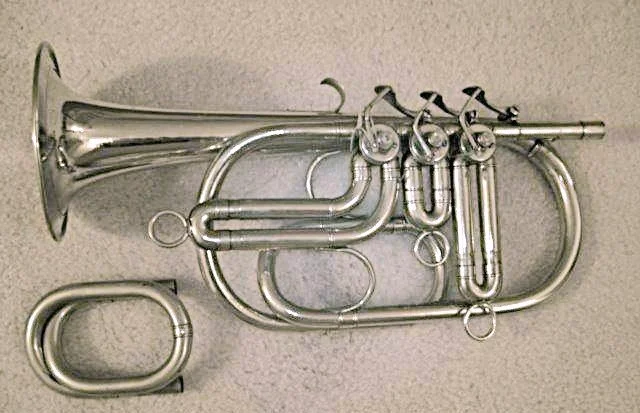
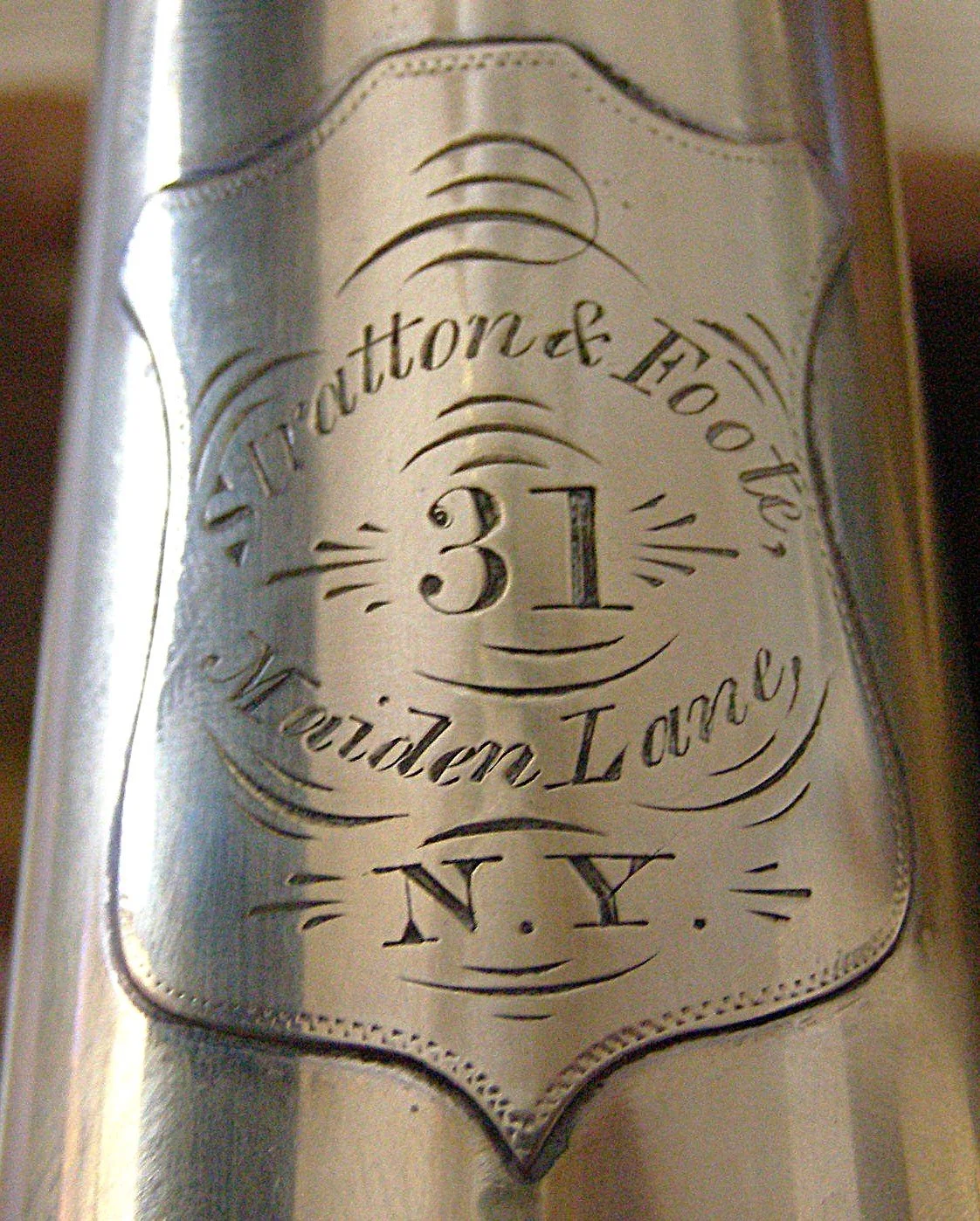
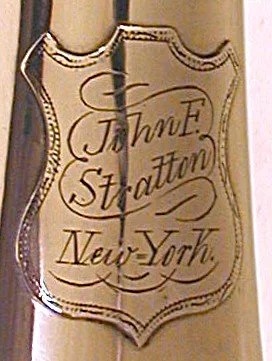
The Stratton and Foote partnership only lasted about a year, but the demand for brass instruments continued its growth trend during the 1860s and 1870s and Stratton was the most successful supplying America with inexpensive European made alternatives to the domestic product. Stratton and Foote claimed to have a factory in New York making all of these instruments, but there is very little evidence to indicate that this was true. It does seem likely that they had what we today might call a “Custom Shop” or “Atelier”, finishing and customizing the imported instruments and parts for some customers. They were also supplying imported parts and complete instruments to other, smaller, shops and music stores for production and marketing under the names of those businesses.
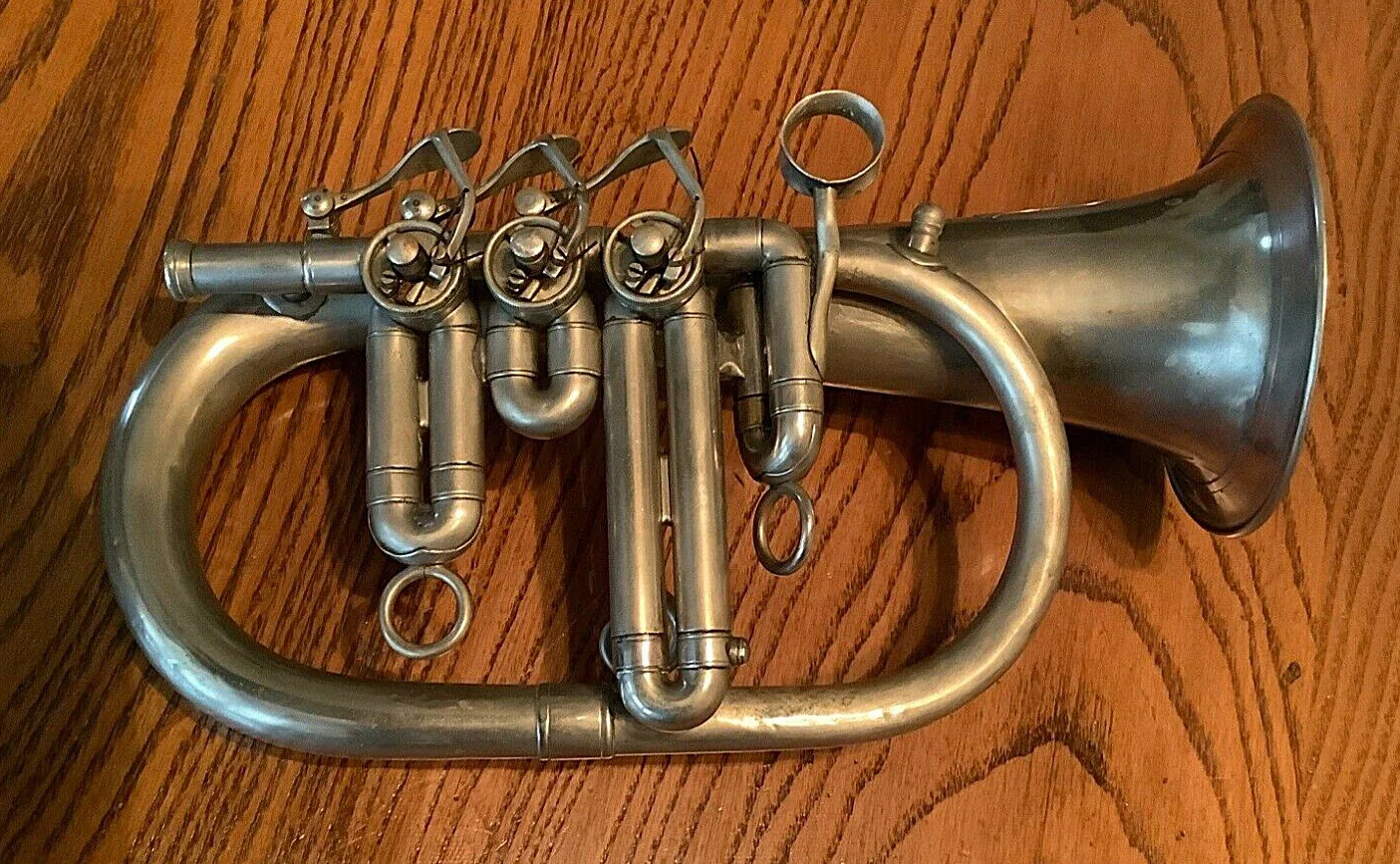
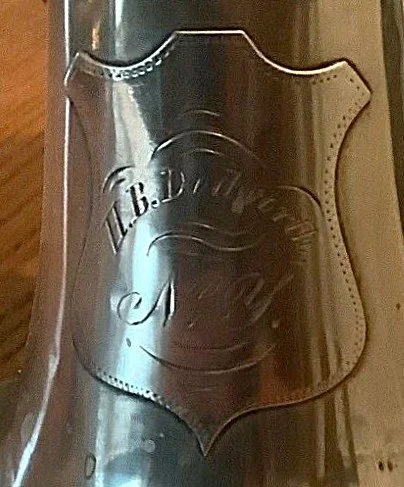
More details were added to this story by one of the most accomplished early American brass instrument makers, Joseph Lathrop Allen. Allen had sold his interest in his original shop in Boston in 1861 and moved to New York City. He was listed in the New York City directories a Musical Instrument Maker from 1862 to 1869, although only four instruments are known to survive from this period. Doing business in lower Manhattan in those same years, he would likely have had an accurate picture of his neighbors in the business. In an interview for an article published in The Boston Globe on November 19, 1905, he commented on a deal proposed while he was still in Boston, by William A. Pond, a publisher, importer and dealer, to sell his instruments in New York. He was quoted: “Boston wanted the best, and New York wanted the cheapest, so I had no dealings with Mr. Pond.” And about the the Civil War: “the bands that were hastily organized were equipped with cheap German instruments, and by the middle of the war all these musicians were sent home…With such a surplus of cheap goods the superior could not profitably compete.” While Allen would have had motivation to exaggerate to make the story better, it still gives some indication of the state of the business.
Still only 50 years old in 1863, Rohé had become a very wealthy man and moved back to Kleinwallstadt where he purchased a home. He also funded a home for the elderly, which still exists today. He is also remembered in his home town in the name of the Josef Anton Rohe Schule (elementary and middle school). He also purchased property in Rome, Italy, where he spent the winters. In 1874, he took one more ocean voyage to New York City via Liverpool, but this time it was likely more for pleasure than business, travelling with Alessandro Quagliotti, a close friend from Italy. He died in Rome on February 12, 1892.
In his will, Rohé left 700,000 Marks (the equivalent of about $5,400,000 today) to the home for the elderly and destitute in Kleinwallstadt to fund an endowment as well as provide the city funds to maintain his mausoleum (which he must have already paid to have built). Another 300,000 Marks (about $2,400,000 today) to the neighboring city of Obenburg for an endowment for “accommodation of the deaf-mutes, idiots, incurable patients and others as a result physical ailments and infirmities of fully employable persons in curative, sick and food institutions, then of helpless orphans in orphanages, of custodial children in rescue facilities or for the creation of free places for orphans or neglected children”. The instructions go on to specify that excess funds be used for scholarships for trade schools and the like. His will also instructed that his gardener was allowed to live in his house in Kleinwallstadt for the rest of his life so that he can enjoy the home and garden and provided 2 Marks a day for his support. 50,000 Marks ($385,000 today) went to each of two relatives (presumed sister in law and niece) in Cincinnati and the balance of his estate was left to Allessandro Quagliotti, his friend in Rome.


Henry Leavitt was even younger, just 33 years old in 1863. Being the junior partner, it’s likely that he received a lesser amount of the buyout, but it still left him very wealthy. At some point during the next eight years, the family moved to England. His brother William stayed in New York, continuing in the bookselling business. In the 1871 census, they were living in Torquay, Devon, with five new servants. In 1872, Henry married Jennie Hatch Shepherd, a widow from Florida, USA and had another daughter, Florence. His daughter Josephine had married in 1877, but the household in Torquay had eight servants by 1881. They also had apartments in De Vere Gardens, London and avenue Marceau in Paris, as well as retaining their home on Staten Island in New York.
Later court records indicate that Leavitt continued a mutually beneficial relationship with his former employee, J. Howard Foote, that didn’t specify any financial exchange and he appointed Foote as his executor in his will. Foote also acted as accountant for Leavitt’s investments in a variety railroad and municipal bonds in the US. That record does not describe anything more specific about their non-business relationship. On August 24, 1881, Leavitt and Foote formed a partnership. As a silent partner he invested $30,00 to purchase 1/3 interest of Foote’s business, which continued in a very similar style as established by Rohé in the 1840s. That is, importing musical merchandise and selling both retail and wholesale. He received 10% per year from his investment, with the possibility of sharing profits over 22,0000 during the year. Rather than improving from the investment, Foote’s business faced stiff competition and continued to decline. Henry died in Spa, Belgium on September 19, 1886. His will was proved by the Surrogate Court in New York.
Post Script:
When Jeff Stockham read what I had written about Joseph Anton Rohé and his instruments, he immediately forwarded to me his communications with Helmuth Lebert, Rohe's second cousin, four times removed, who still lives in Kleinwallstadt and has done much research into his life. I have incorporated some of this information into the story above and we will likely learn even more in the near future.