
Post Horn and Keyed Bugles by Richardson & Co., Rochester, New York

This is another very rare instrument from Mark Elrod's collection. It is one of four instruments known by Samuel W. Richardson of Rochester, New York, the others being two Eb keyed bugles and one Bb keyed bugle. One of the Eb bugles and the Bb are shown here in the last two photos. There is no known connection between this maker and B.F. Richardson of Boston.
Samuel Wood Richardson was born on April 10, 1805 in Woodstock, Connecticut to Alpheus and Betsy Wood Richardson. In "Graves & Company, Musical Instrument Makers", Robert Eliason reported that Richardson was a partner in that company in Winchester, New Hampshire from 1832 through 1839. All four of the instruments signed by Richardson very closely resemble instruments made by Graves & Co. This instrument is very much like the post horns made by Graves although has a larger more cornet like bell. In 1834, Richardson married Harriet Locke Alexander, who might have been related to Elijah and Charles Alexander, also partners in Graves & Co. In about 1850, Samuel and Harriet Richardson were in England, where their daughter Harriet was born. Of course, we don’t know the purpose of their visit.
In "Keyed Bugles in the United States", Eliason states that Richardson was listed in the Rochester city directory in 1847 as musical instrument maker. He was also listed that way in 1849 and 1850, but in 1851 he was listed at the same address as an upholsterer. In 1866, he was listed as “patent leg maker” and from 1870 until 1873 as “machinist”. He pursued a number of trades including enlisting as a First Class Musician in the 26th New York Infantry Band in October 1861, at which time he was 54 years old. Richardson died in March 13, 1873.
Click an image below for larger views.


This instrument at first appeared to have survived well but the restoration was extensive and time consuming. All of the smaller curved tubing was splitting at the seams and previous repairs made things worse. At least a dozen patches were needed to cover all the breaks. The first piston assembly had been broken, repaired and broken again and it was decided to make a whole new assembly in order to be playable and the original put aside. The Ab crook is obviously original, fitting the instrument and the case. The discrepancy of tuning Bb compared with Ab and the fit of the mouthpiece indicated that it had originally been equipped with a shank or bit for the higher pitch. Not having one to copy, I made a guess as to how it might have looked. The mouthpiece has a ring of corrosion indicating that it had been from a different instrument and may indeed be from an Eb keyed bugle from the period.


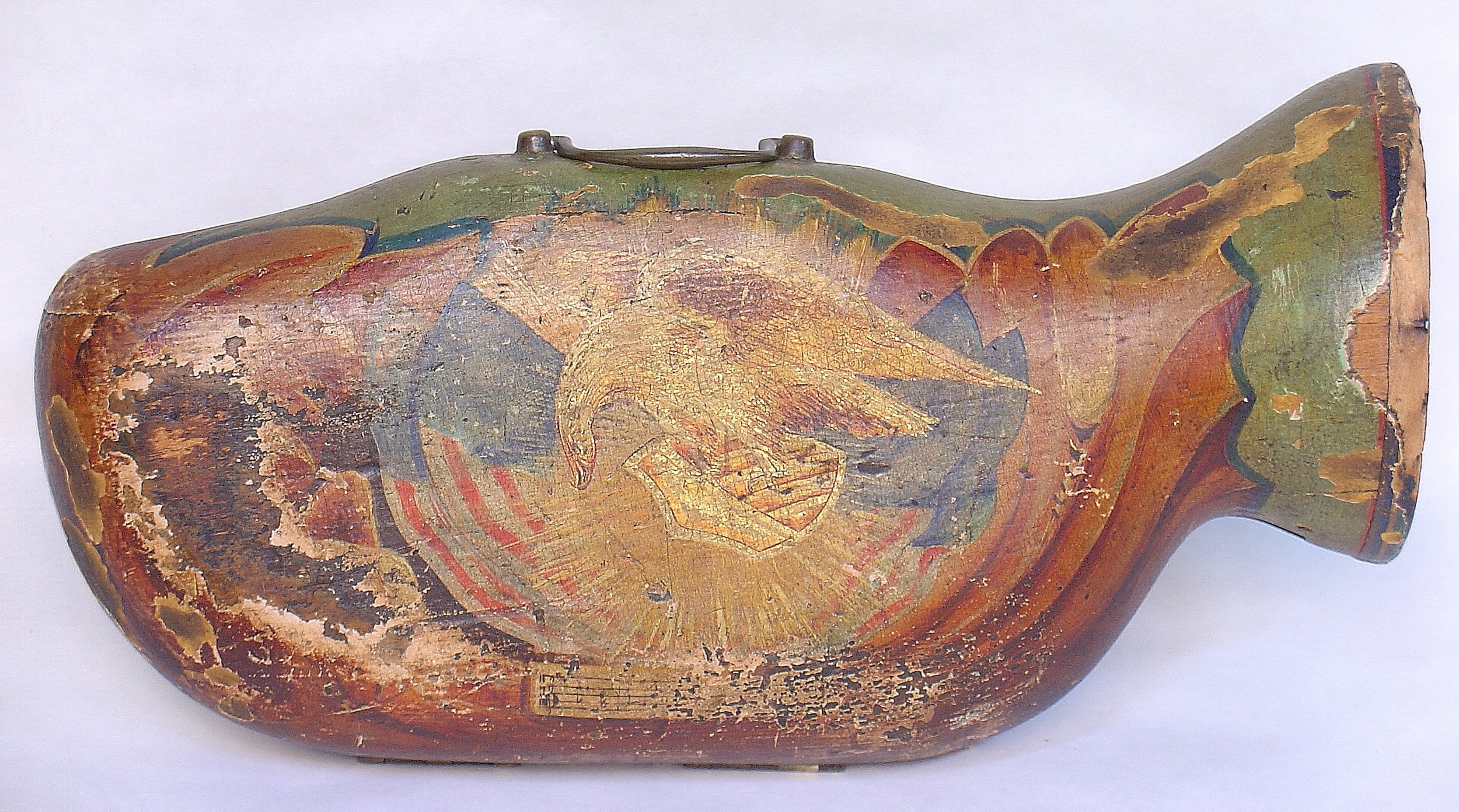
As you can see in the photos below, the case itself is a remarkable thing. We can only speculate, but it seems likely that the painted decoration is the artistic inclination of the original owner and includes his name: "Wolsin". He also painted a short musical quotation, which, unfortunately has been worn off, although the opening notes could be from "Star Spangled Banner". The fabric lining is an unfortunate recent addition which prevents the instrument from fitting as well as it should. The length of this instrument without mouthpiece or crook is 12 13/16", the bell rim diameter is 4 9/16" and the bore measures .367".


Lastly, below are photos of Bb and Eb keyed bugles made by Richardson in Rochester, again looking very similar to the Graves products made in Winchester, New Hampshire.


