
Albert Valve, British Valve and Serpentine Valve Cornopeans, 1845 to 1850
Robert Bradshaw and RObinson and BUssell


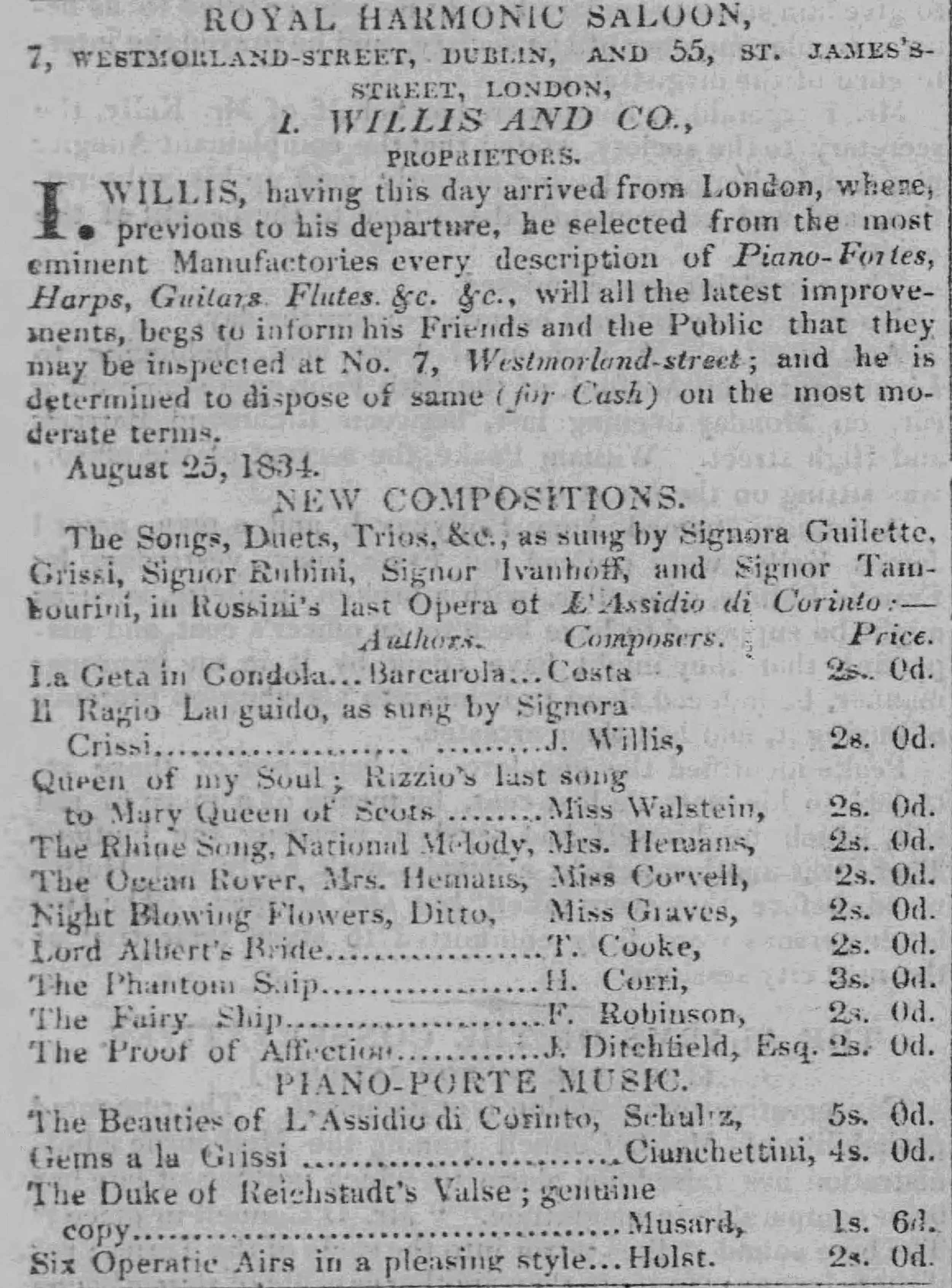
The partnership of Robinson, Bussell and Robinson was formed when they succeeded Isaac Willis’ “Harmonic Saloon” (sometimes called the “Royal Harmonic Saloon”), at 7 Westmorland Place, Dublin in 1836. The focus of the business was pianos and sheet music, but they dealt in all instruments for which there was demand. The original partnership was Francis Robinson, Henry Bussell and William Robinson. Continued advertising in Dublin papers indicates that they were successful in the business as Willis had established.


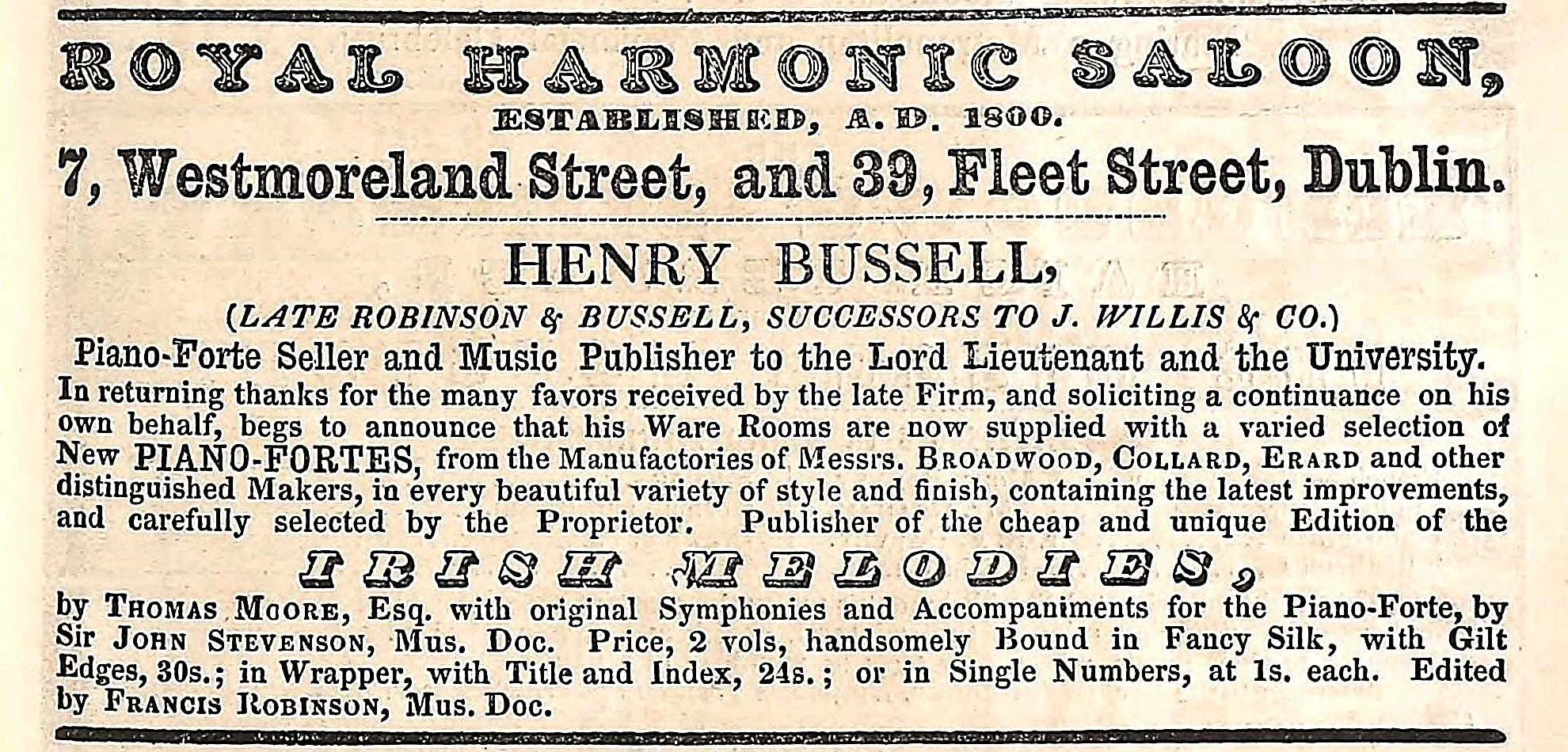
In about 1841, the partnership’s name was shortened to “Robinson and Bussell”. Perhaps it was always a family business, and younger brother Joseph Robinson was also involved and possibly John as well. The four Robinson brothers, Henry Bussell and at least two of the Robinson’s wives were very active in the highest echelon of Dublin’s music culture. They all played piano and organ and sang in both church and concert hall. Francis, the oldest brother, achieved Doctor of Music around 1860 and commissioned a large house built, named “Undercliffe”, in the wealthy Killiney suburb of Dublin. He was a friend of Thomas Moore and Sir John Stevenson and became a vicar choral and organist at St. Patrick’s Cathedral as Stevenson had earlier in the century.
By 1853, Henry Bussell was the sole named owner of the Royal Harmonic Saloon and continued to advertise the availability of military musical instruments until 1856. The business was always focused on sales of pianos and printed music, continuing until 1880. Bussell was also very active as secretary of the Philharmonic Society, president of the Irish Musical Fund (benevolent) Society, performed on piano and served as conductor in many concerts. Before his partnership with the Robinsons, he had been organist at Booterstown Church and Chapel Royal (Dublin Castle).


Only two instruments known to survive that Robinson and Bussell signed, along with a third (the first made) by the designer of all three, Robert Bradshaw. I attempt to clarify the facts here, but the story is surprisingly complicated, many facts remain to be discovered, and we are tempted to fill in the gaps with speculations. While the three cornets share similar design concepts, a lucky twist of fate makes them examples of three different designs, which their makers registered in three different years under the Design Act of 1843 in London. This act of Parliament allowed makers to register and protect designs for three years at a much lower cost than filing for a patent.
Robert Bradshaw, a clock and watch maker at 36 Lower Ormand Quay in Dublin, designed—and possibly made—the instruments. The city directories show his timepiece business in Dublin by 1820, although from 1844 to at least 1859, described him as a “musical instrument maker.” Nothing more was found about his clock and watch making business. He must have produced only a small number of instruments, since researchers and collectors have found no others bearing either his own name or that of Robinson and Bussell.
In a number of newspaper advertisements beginning in October 1838, Robinson, Bussell and Robinson indicate that they made “Military Musical Instruments.” In the first of these, they stated that they had “purchased from Mr. ELLARD his entire Stock of Tools, Models, Patterns, and Machinery.” “Mr. ELLARD” clearly refers to Andrew Ellard, who remained active as a maker until 1838. Rather than quote more of this very long advertisement, I present it below in its entirety. The advertisement makes interesting reading, although descriptions are not always clear, perhaps because the author lacked thorough familiarity with brass instruments. It is equally possible that people in Dublin used these descriptions at the time. The term “Best Russian Valve” does not correspond to valve types that makers used during that era, except in a trumpet method book that Thomas Harper Sr. published in 1835. In that book, Harper uses the term “Russian valve” in the caption of an illustration of a trumpet with two Stölzel valves. Ed Tarr speculated that it was a misprint of the term “Prussian valves,” since they were first developed in Prussia. Robinson and Bussell likely knew of this book.


Ellard had taken over marketing keyed bugles from Johann Bernhard Logier in 1818. Only one keyed bugle is known to be signed by Logier. For more background, information on the earliest keyed bugles is found in Ralph Dudgeon’s “The Keyed Bugle”, including sources indicating that Logier didn’t make bugles. It is hard to imagine that a maker as small as Ellard, with so few surviving instruments, produced such a wide variety of instruments. Perhaps Ellard imported most instruments from other makers, or perhaps, parts to be assembled in his shop. While there were several makers of brass instruments in Dublin during the early 19th century, the community of small shops didn’t likely adopt the industrial technology that existed in Markneukirchen, Paris, London and other industrial hubs. Another explanation, of course, is that after over 150 years of obsolescence, of interest only to a few eccentrics, the survival rate might be that small.
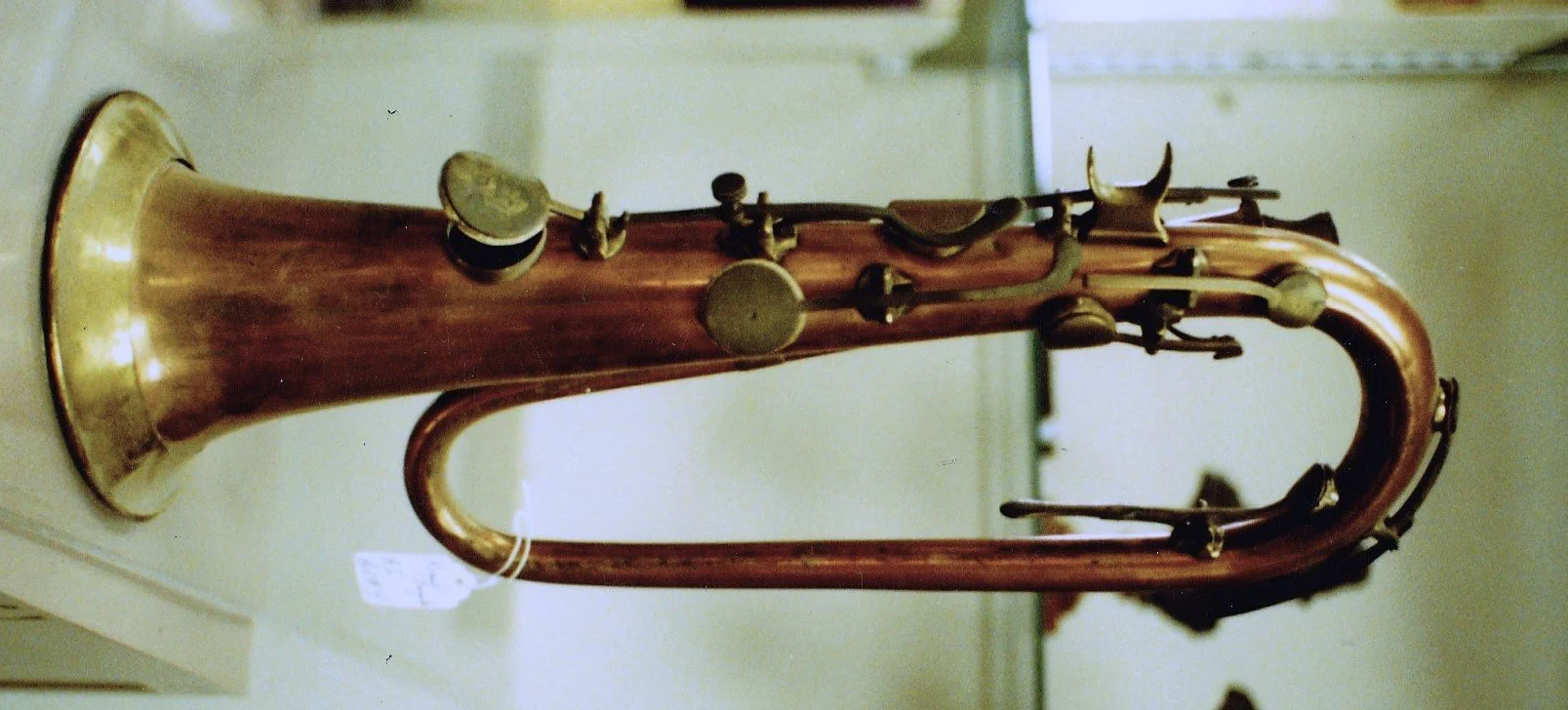
About ten surviving instruments bear Ellard’s signature, including flageolets, keyed bugles, a serpent, a horn, a cornopean and a flute. The image below shows a seven-keyed bugle with a tuning mouth-pipe, as indicated in Robinson, Bussell and Robinson’s first advertisement. The curved key cups or heads may match what they described as “crescent keys” in that advertisement. An October 14, 1823 announcement in the Dublin Freeman’s Journal states that “Mr. Hyde” (John Hyde, well known performer on trumpet and bugle, who also claimed to have invented the slide trumpet) “…is the inventor of an instrument called the CRESCENT HORN, which possesses all the power of the Key Bugle, which is capable at the same time of tones so soft and melodious, as to accompany the Piano forte or the voice”. This design is also seen in keyed bugles by Dollard of Dublin and C & F Pace of London. Members of the Dollard family were active in Dublin from about 1800 to at least 1834. Matthew Pace and his sons, Charles and Frederick were making keyed bugles in Dublin before moving to London in about 1816. Another signed by Muzio Clementi & Co. of London, who didn’t likely have facilities for manufacturing keyed bugles, but has a direct connection to Logier. In “Clementi's Music Business”, David Rowland presents a letter from Logier to Clementi & Co., stating that they should have received “6 Kent Bugles & Trumpets” with 24 more on the way.
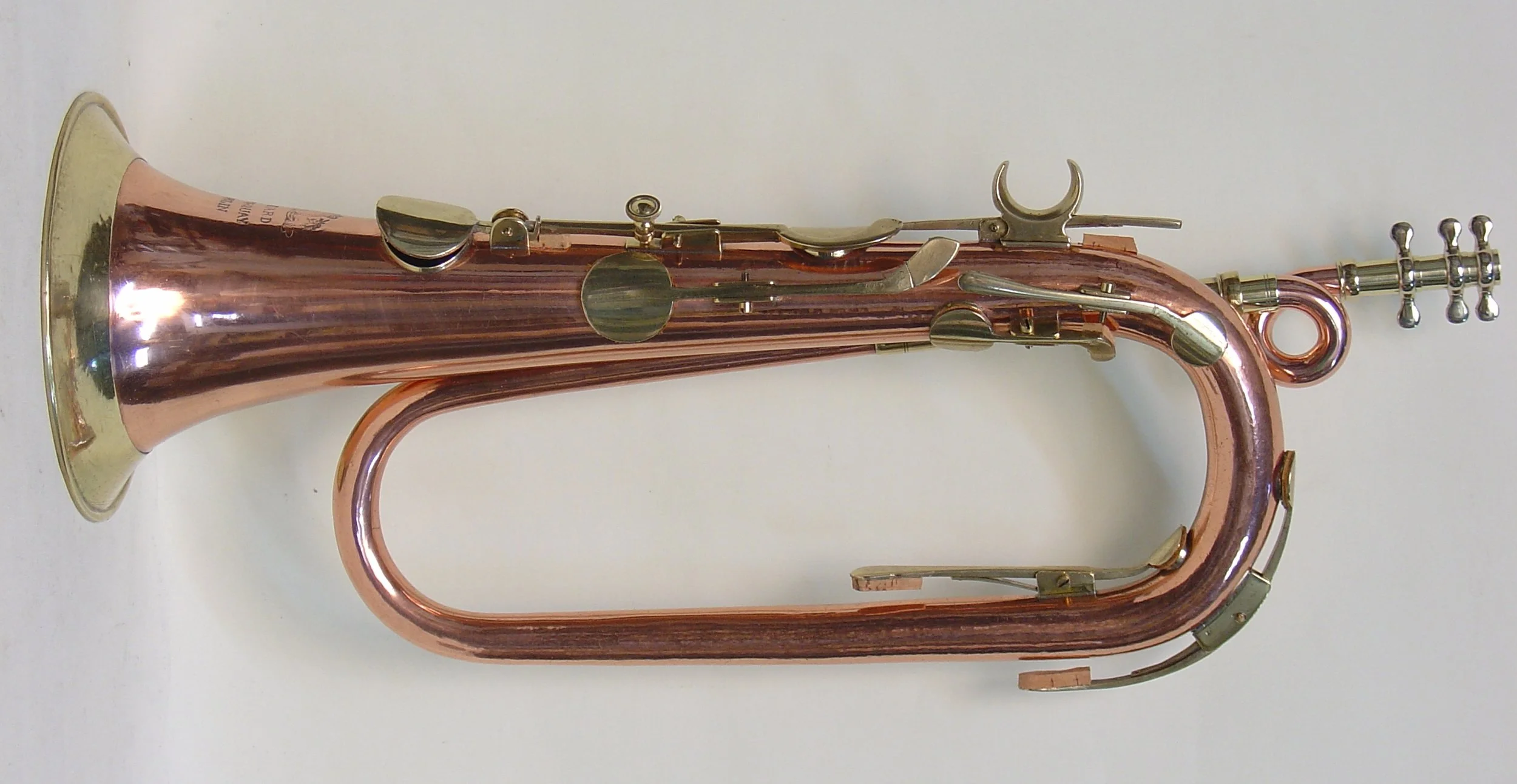
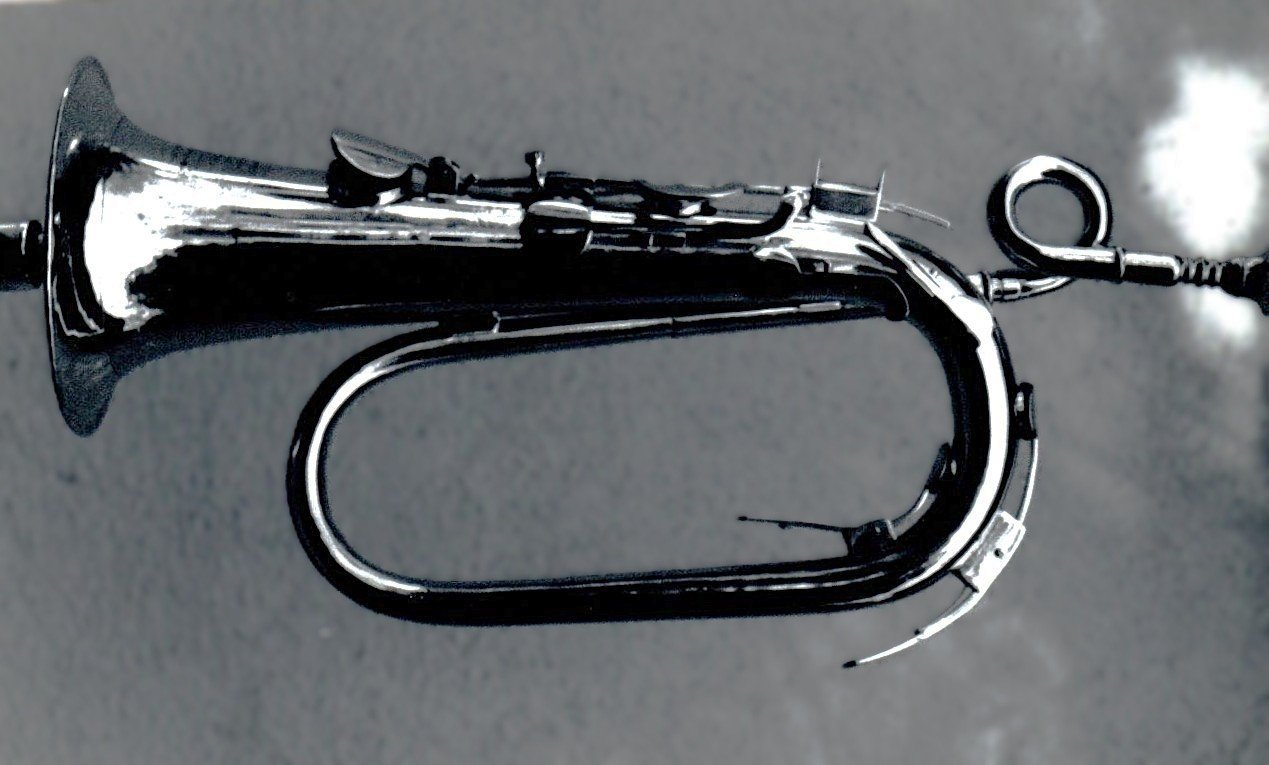
Andrew Ellard does not appear to have continued in the musical instrument business after 1838. In the early 1850s, he was living at 10 Tritonville, Irishtown, with Robert Bradshaw, and in 1856 he lived a few doors away. The press referred to him as “Esq.” and most often mentioned him in connection with his service on grand juries and on the committee that determined grand jury rates.
Robert Bradshaw continued to appear in the Dublin directories as a musical instrument maker until 1859. However, he became insolvent in 1852, and the only evidence of his activities after 1850, is Bussell’s 1854 advertisement mentioned above.
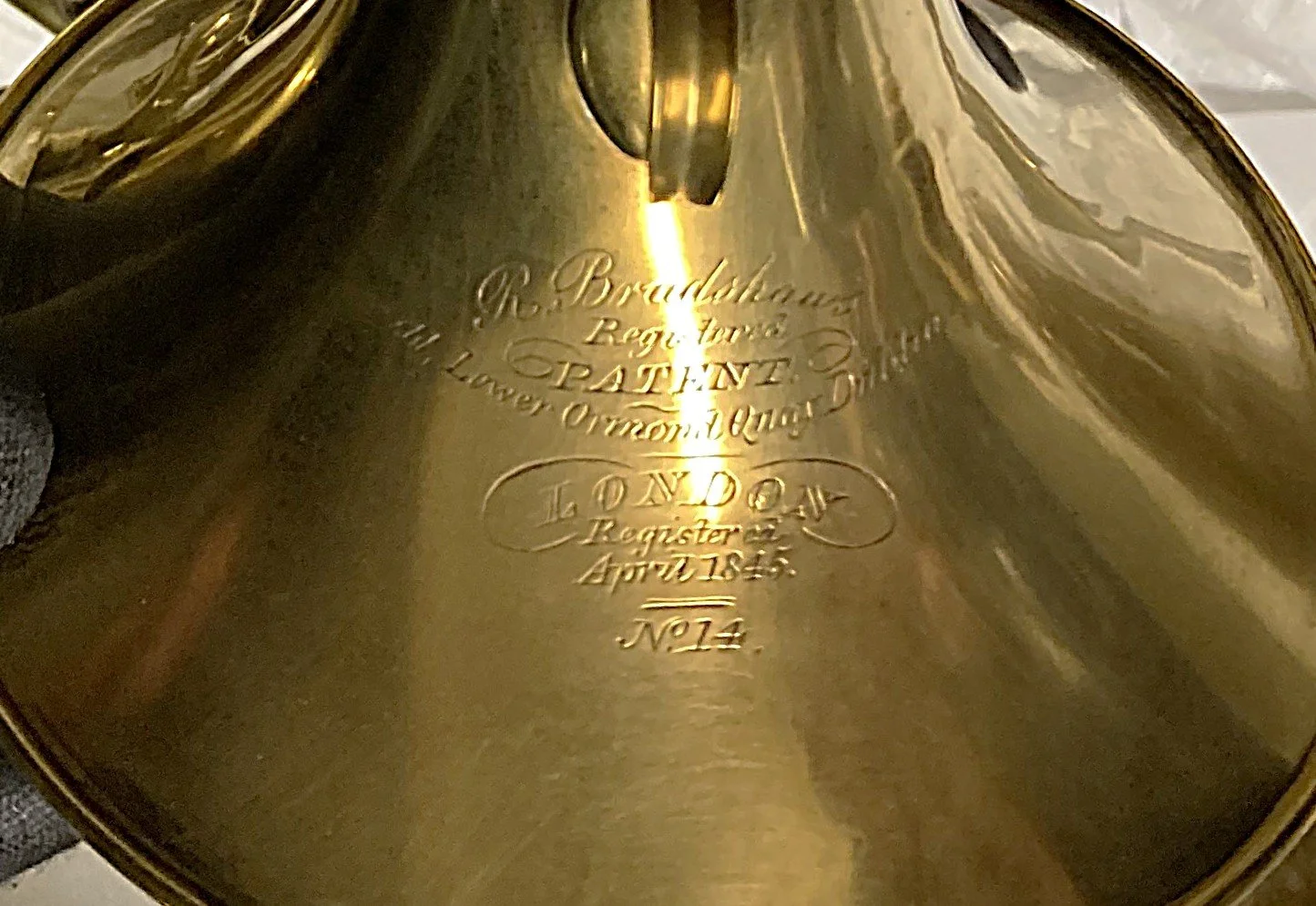
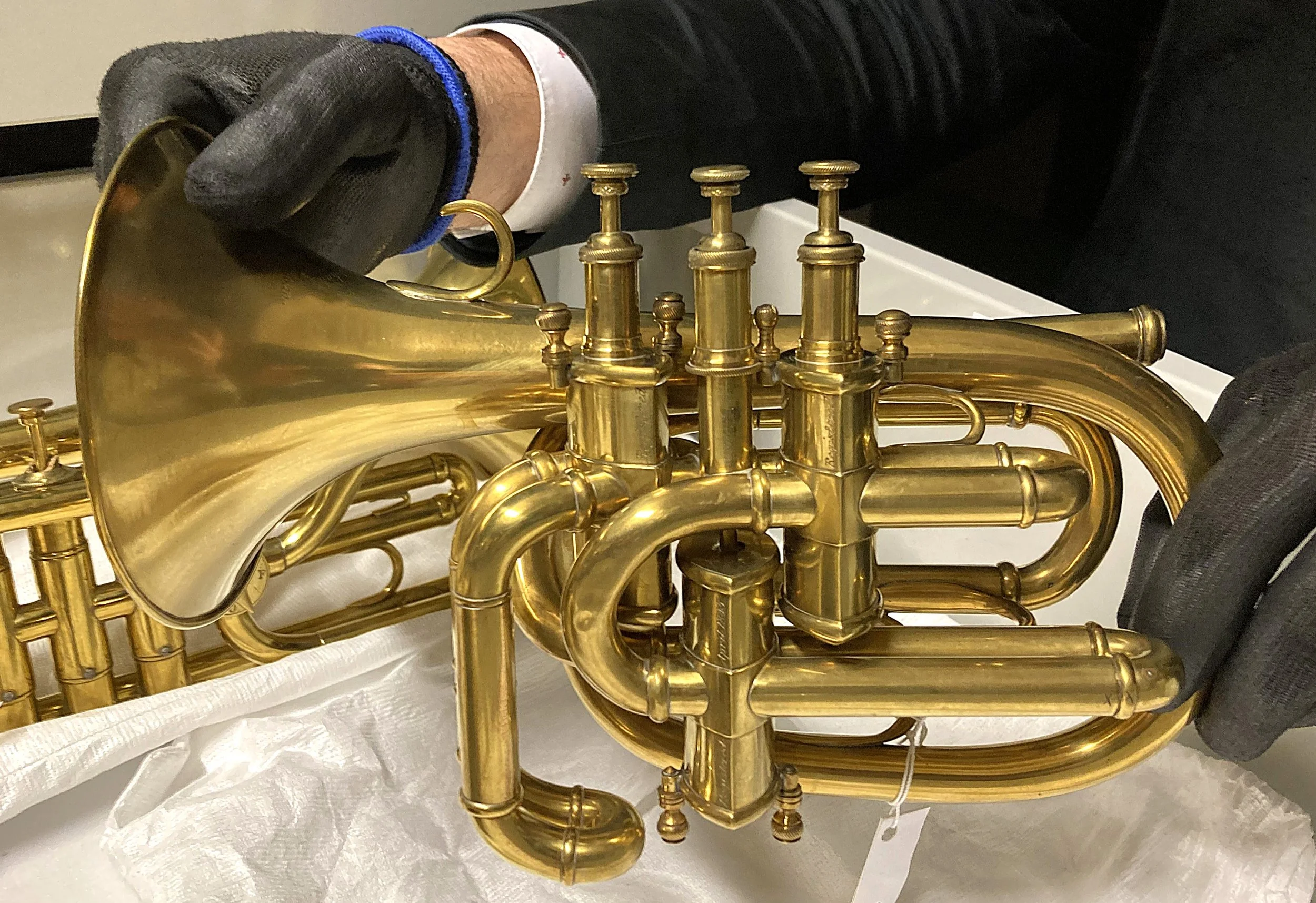
Robert Bradshaw registered his first cornet design on April 7, 1845, under the title “The Albert Valve for Cornet-à-Pistons, Trombones, Ophicleides, etc.” He likely chose the name to honor Prince Albert, although no source states this explicitly. Only one known example of this design survives, in the collection at the Brussels Musical Instrument Museum accession number 3163. Géry Dumoulin, curator of this collection, described this cornet in an article published in the Historical Brass Society Journal (2002 page 429). Further research must determine whether Bradshaw also patented this design, as the engraving on the bell of the cornet claims; although the engraved date matches that of the registered design. The design aimed to remove the bore restrictions in the tubes that passed through the pistons, including with the valve slides engaged. Each piston has an internal 180-degree curve, presumably without bore restrictions, engaged with the valve at rest that is the same radius as the crook on the valve slide that is engaged with the valve down.
The design placed all the tubing through the valves in the same plane, following the same concept used in Berliner pistons or rotary valves . In both of those systems, makers could remove the bore restrictions by enlarging the valve bodies. A few makers adopted this approach, but it never gained the popularity of the more compact versions because the larger, heavier valves returned more slowly. In the Albert valves, the maker reduced the mass of the pistons by shaping them oblong in section as seen in the fourth photo below. Géry Dumoulin reports that the valves do not seal tightly enough to make the instrument suitable for performance. Given the excellent state of preservation and the known difficulty of fitting irregularly shaped valves, the cornet may never have functioned satisfactorily.
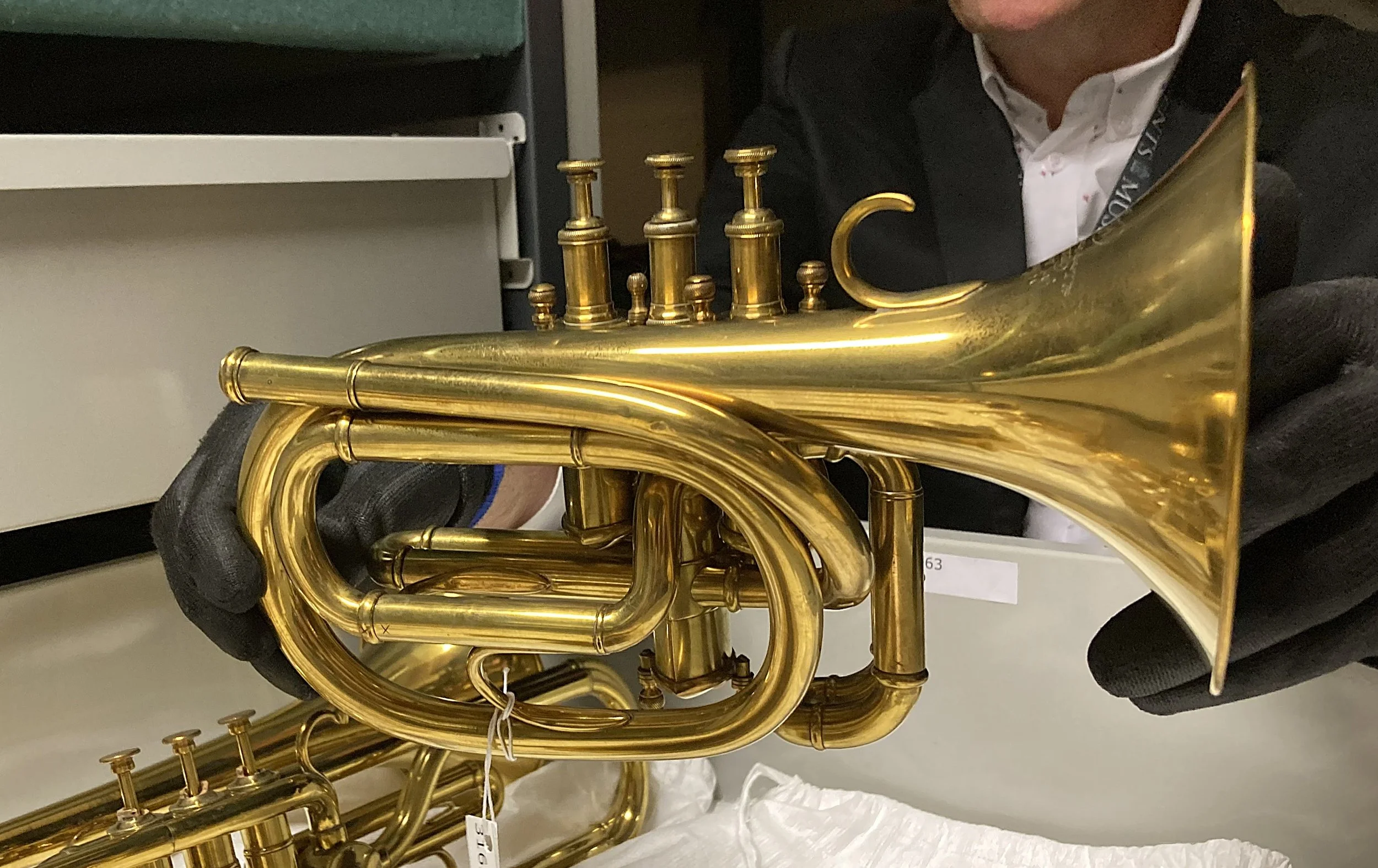
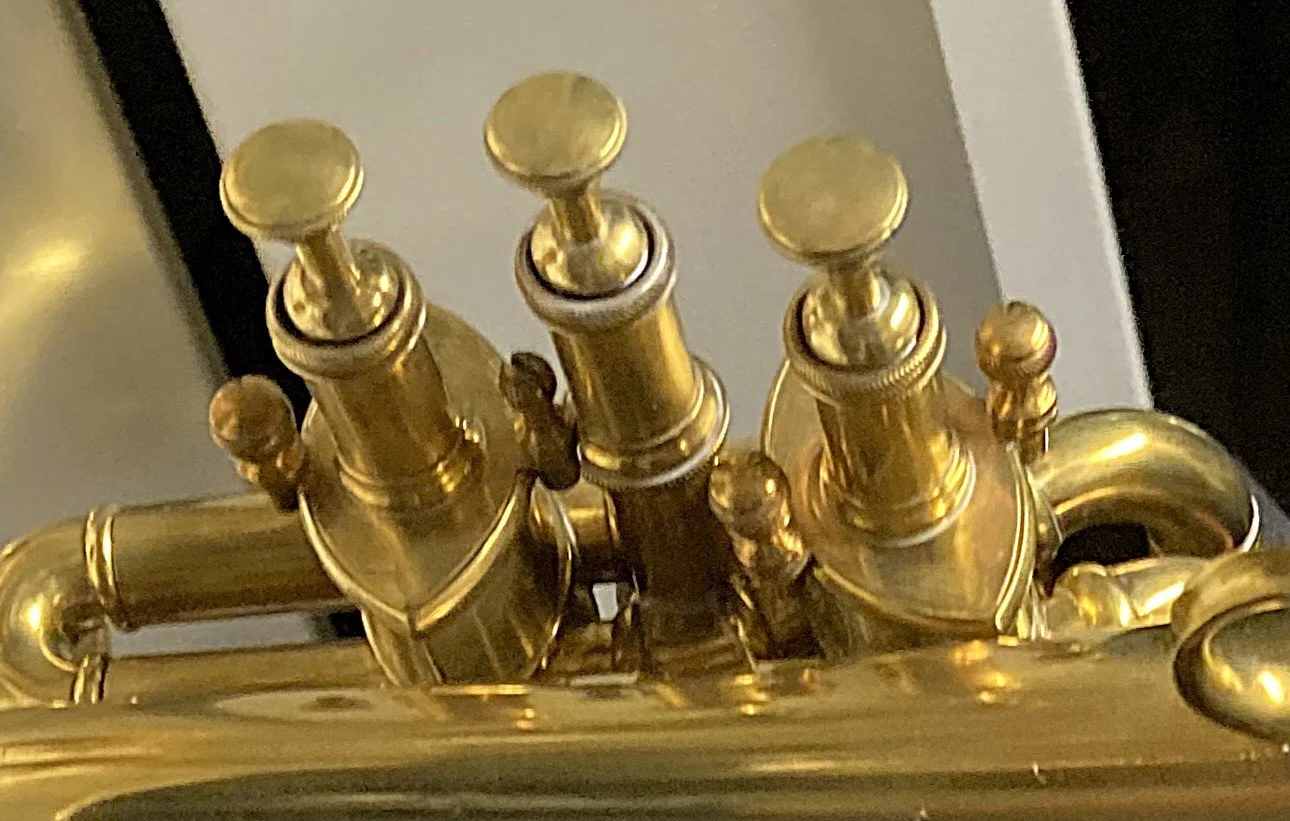
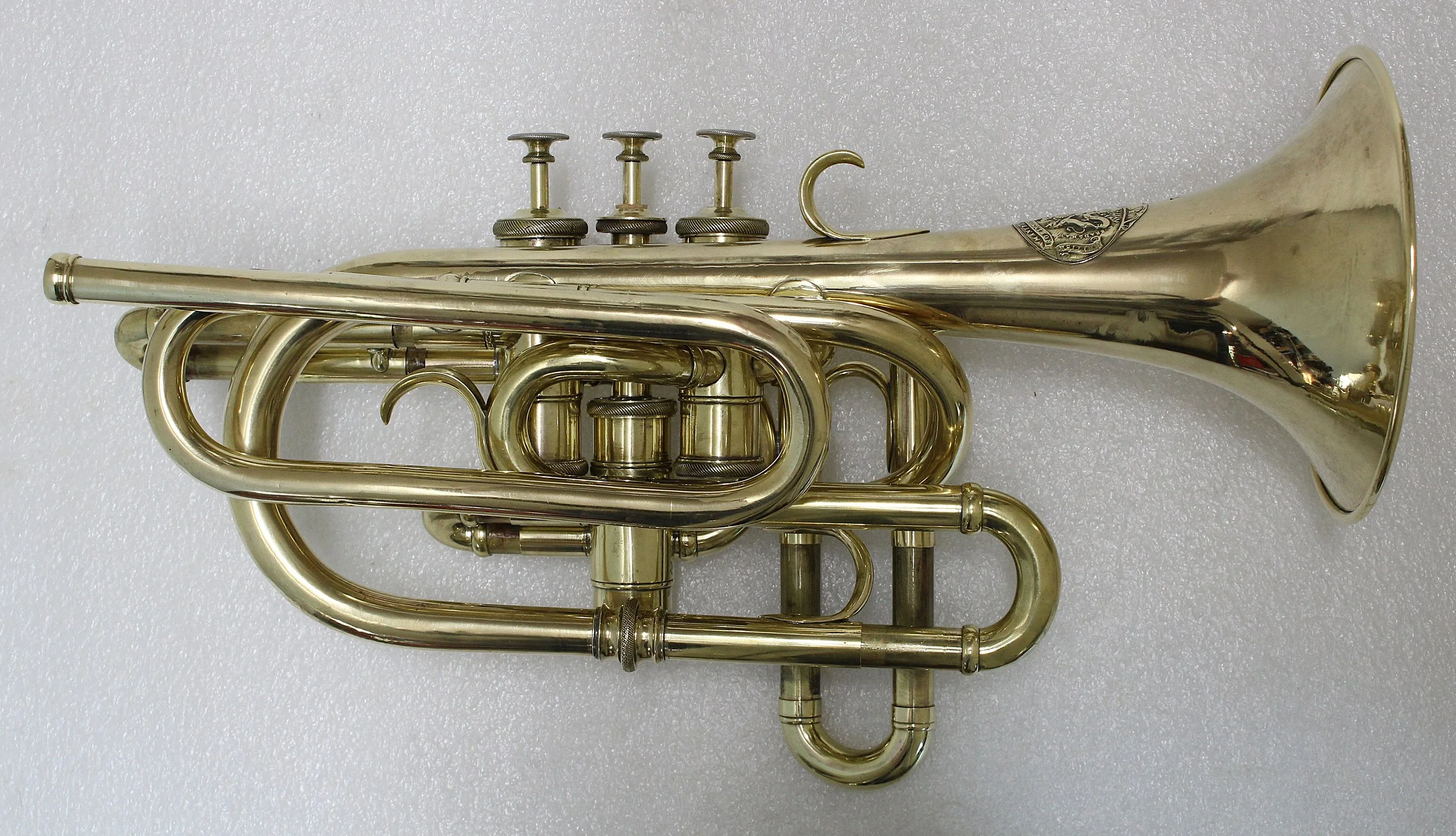
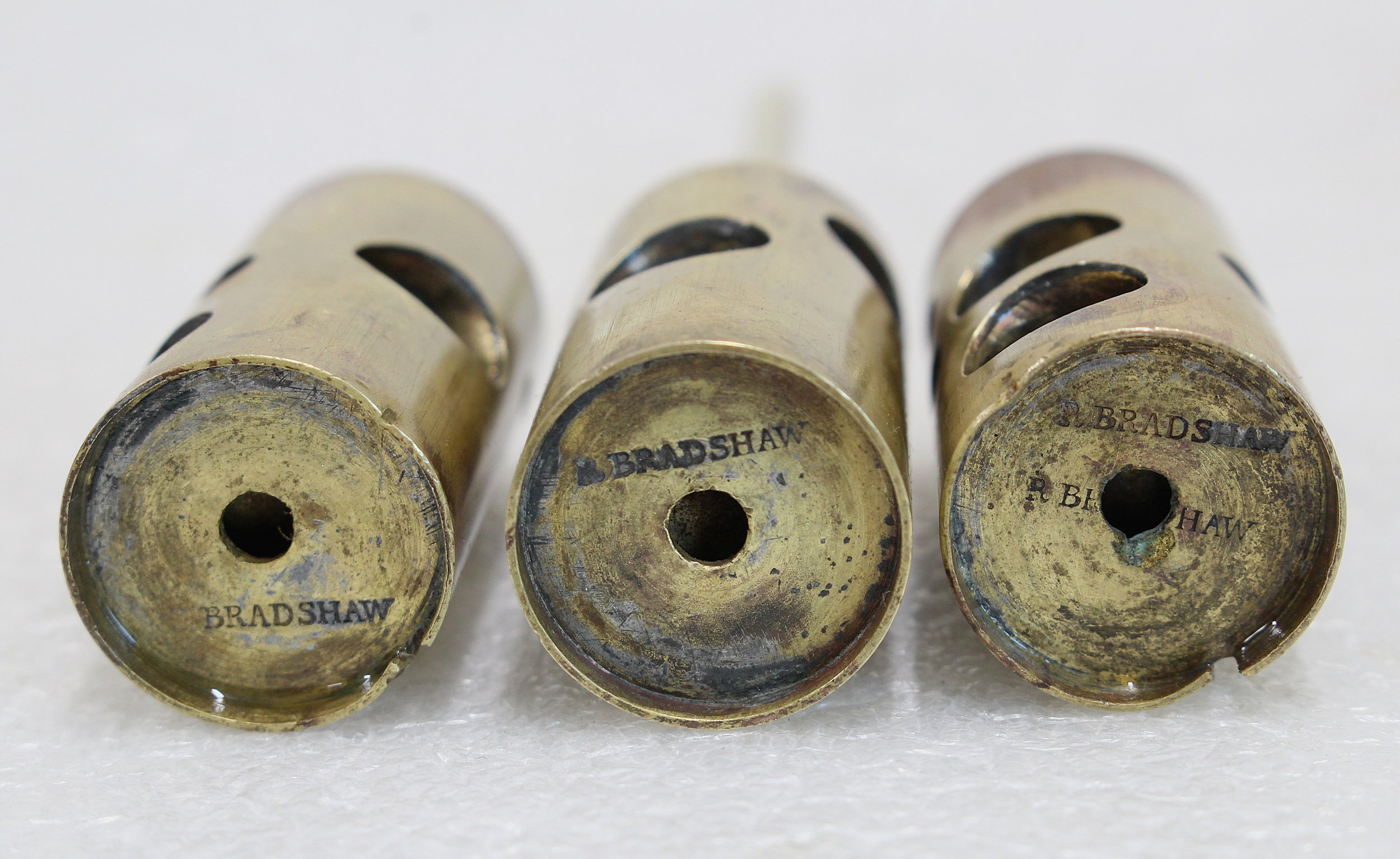
Steve Ward’s collection includes the next of these cornets, which reflects a design registered on August 21, 1846. Robinson and Bussell registered the design under the name “Bradshaw’s British Valve”. It follows the same overall design as the earlier example with Albert valves, except for a modification to the valves themselves. They are round and placing the tubing at different vertical levels allowed enough space for all the tubes within the piston to be full bore. As a result, the design produced pistons with the same diameter as Berliner valves of the same bore size, but without bore restrictions. This concept was used again in saxhorns by Paris maker Halary in the 1870s.
This cornet remains well preserved and functions as a very good playing instrument. In all three cornets featured here, Bradshaw placed the half step in the first valve; however, in the last two designs, he made the longer whole-step slide assembly interchangeable with the half-step slide. The arrangement of the half step in the first valve was not unusual in very early valved brass instruments and continued to be popular in certain countries, including Ireland. This topic is thoroughly covered in the article “The ‘Catholic’ Fingering—First Valve Semitone: Reversed Valve Order in Brass Instruments and Related Valve Constructions”, published in the Historic Brass Society Journal, Volume 15, 2003, by Joe Utley and Sabine Klaus. In the second photograph below, the half step slide is inserted in the first valve tubes and the whole step in the second.
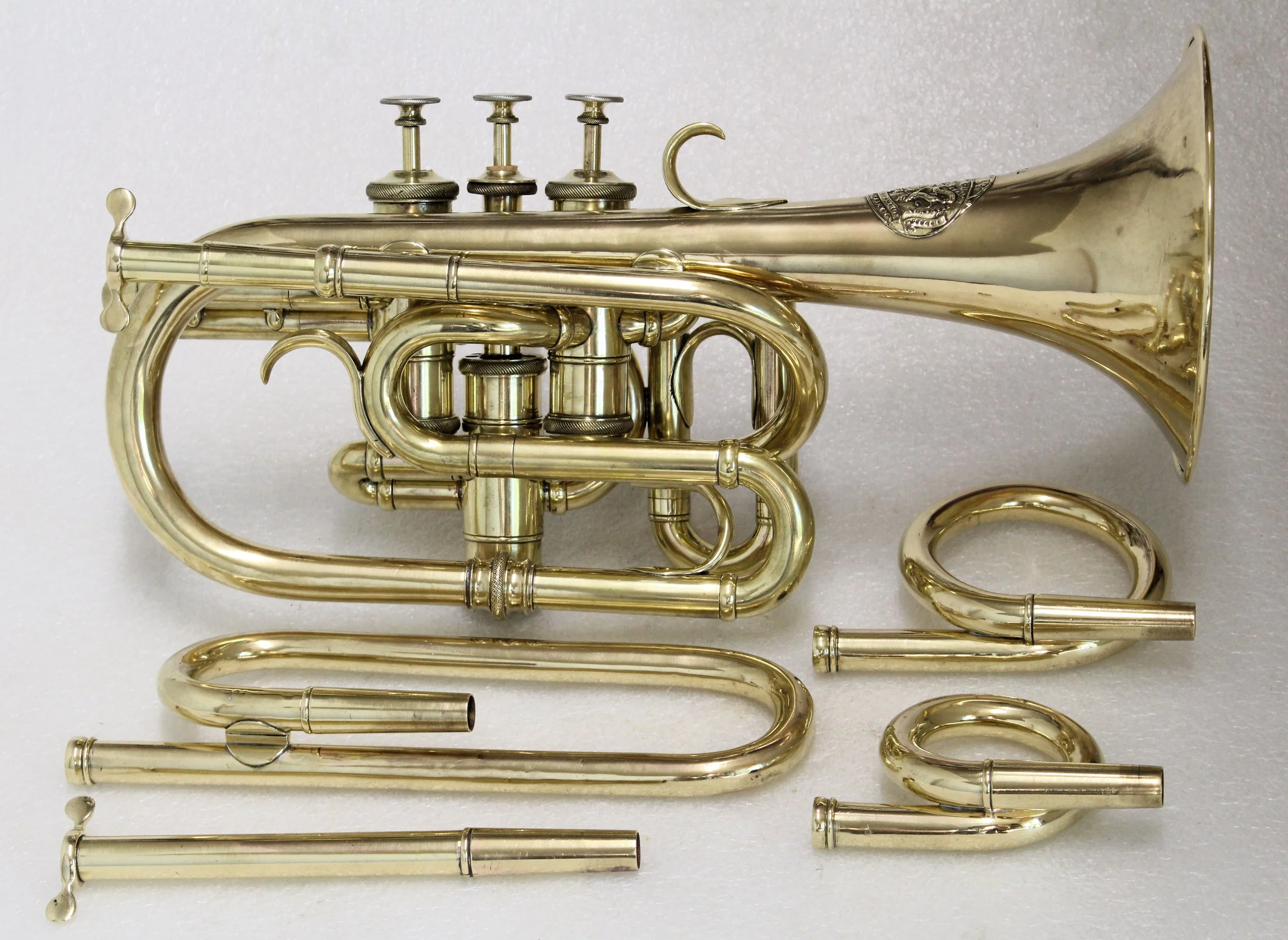
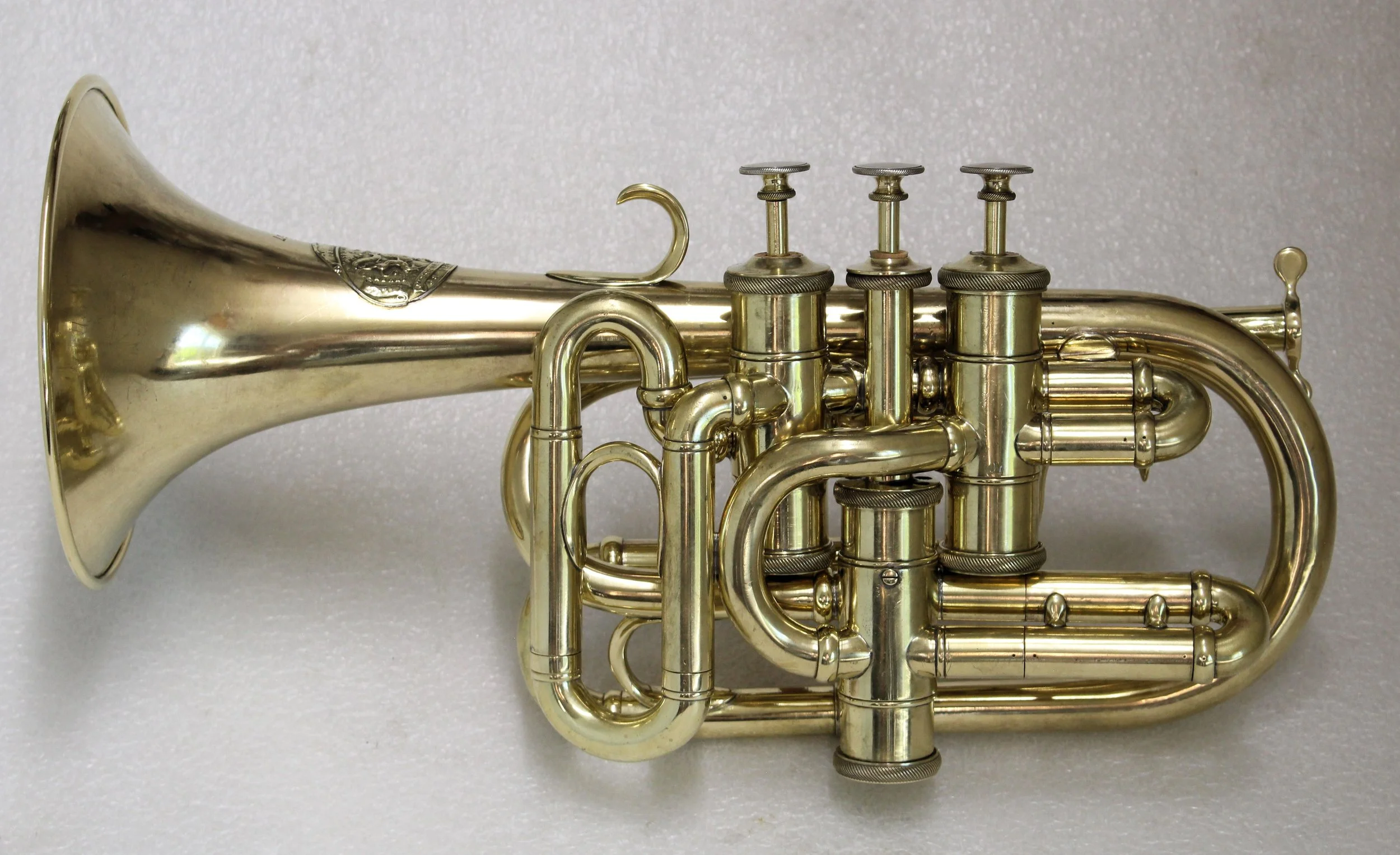
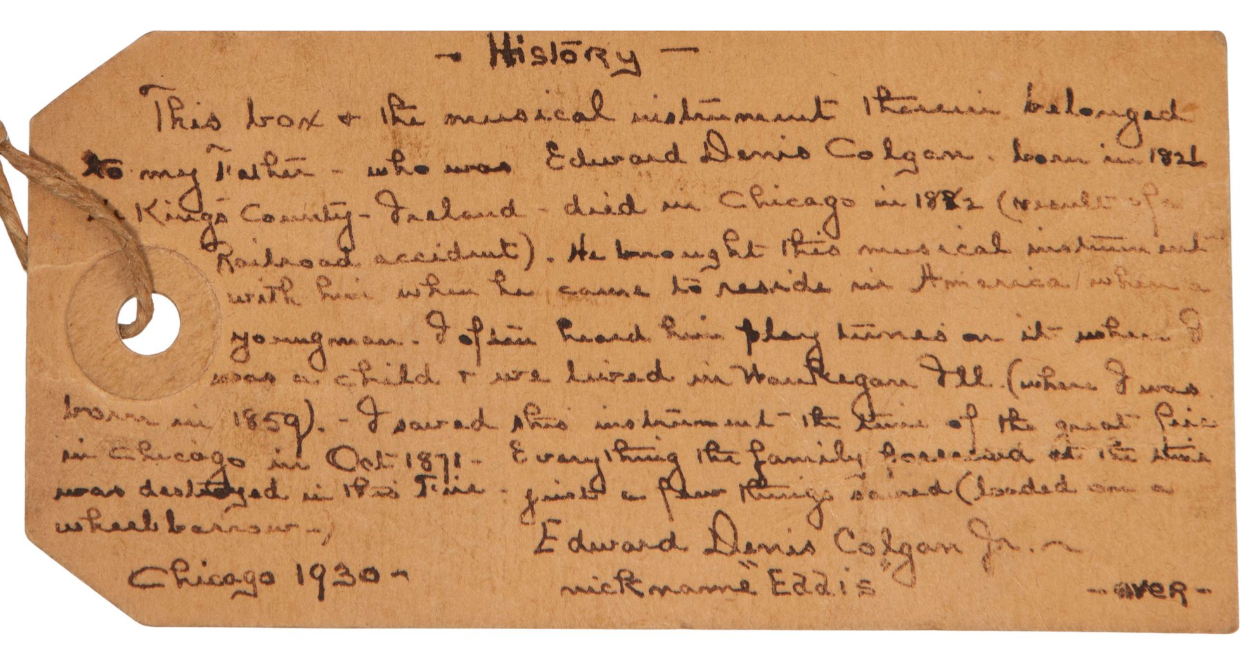
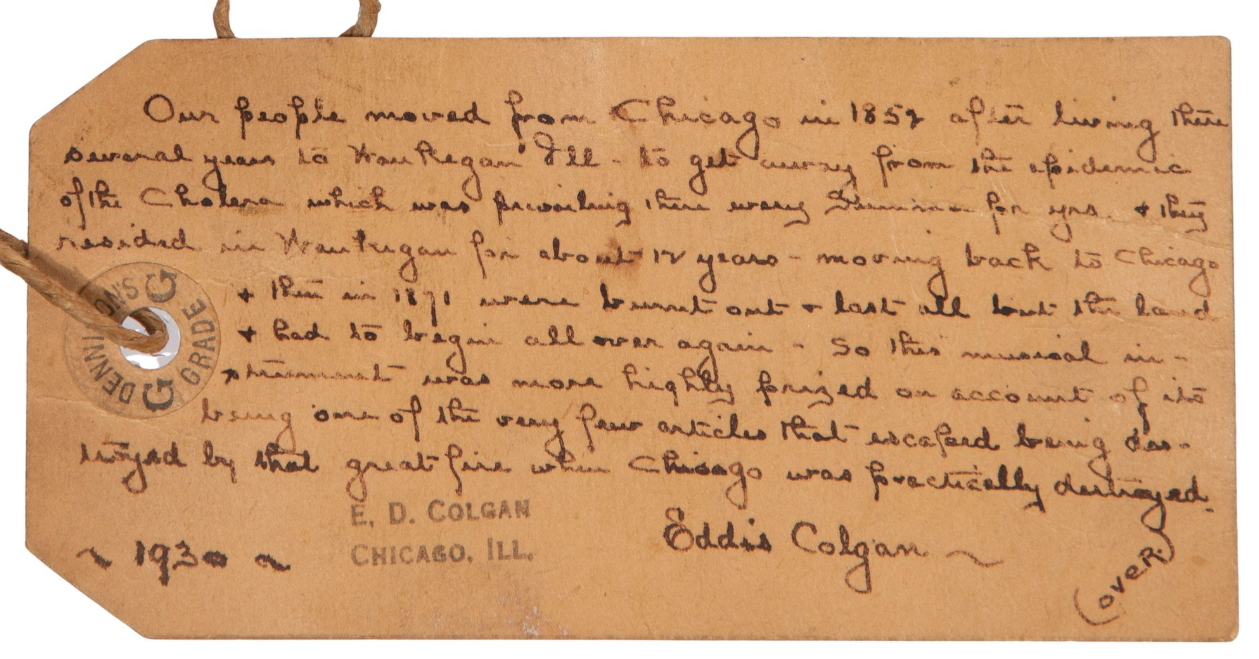
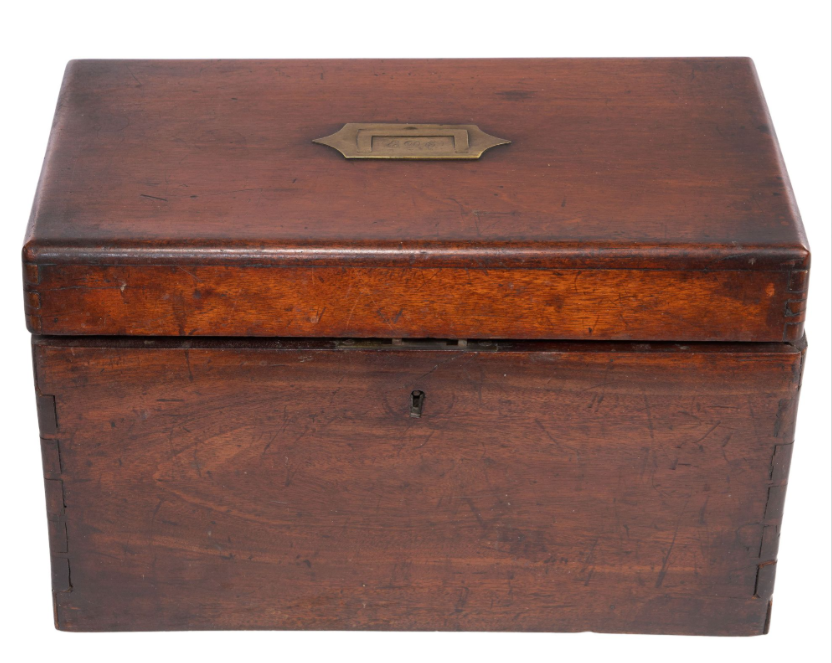
The son of the original owner preserved the history of the British valve cornet, written on a single paper tag, reproduced below. He also preserved the original deluxe case and the complete kit of parts, including mouth-pipe shanks for B♭ and A, crooks for A♭ and G, and the mouthpiece.
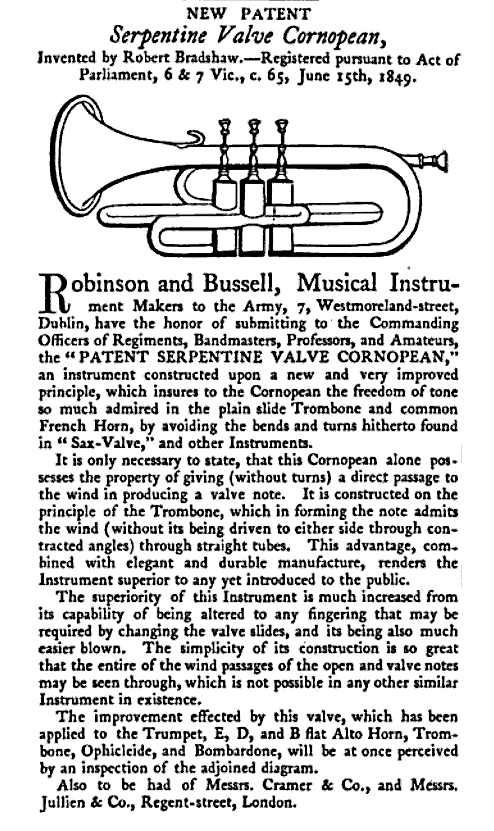
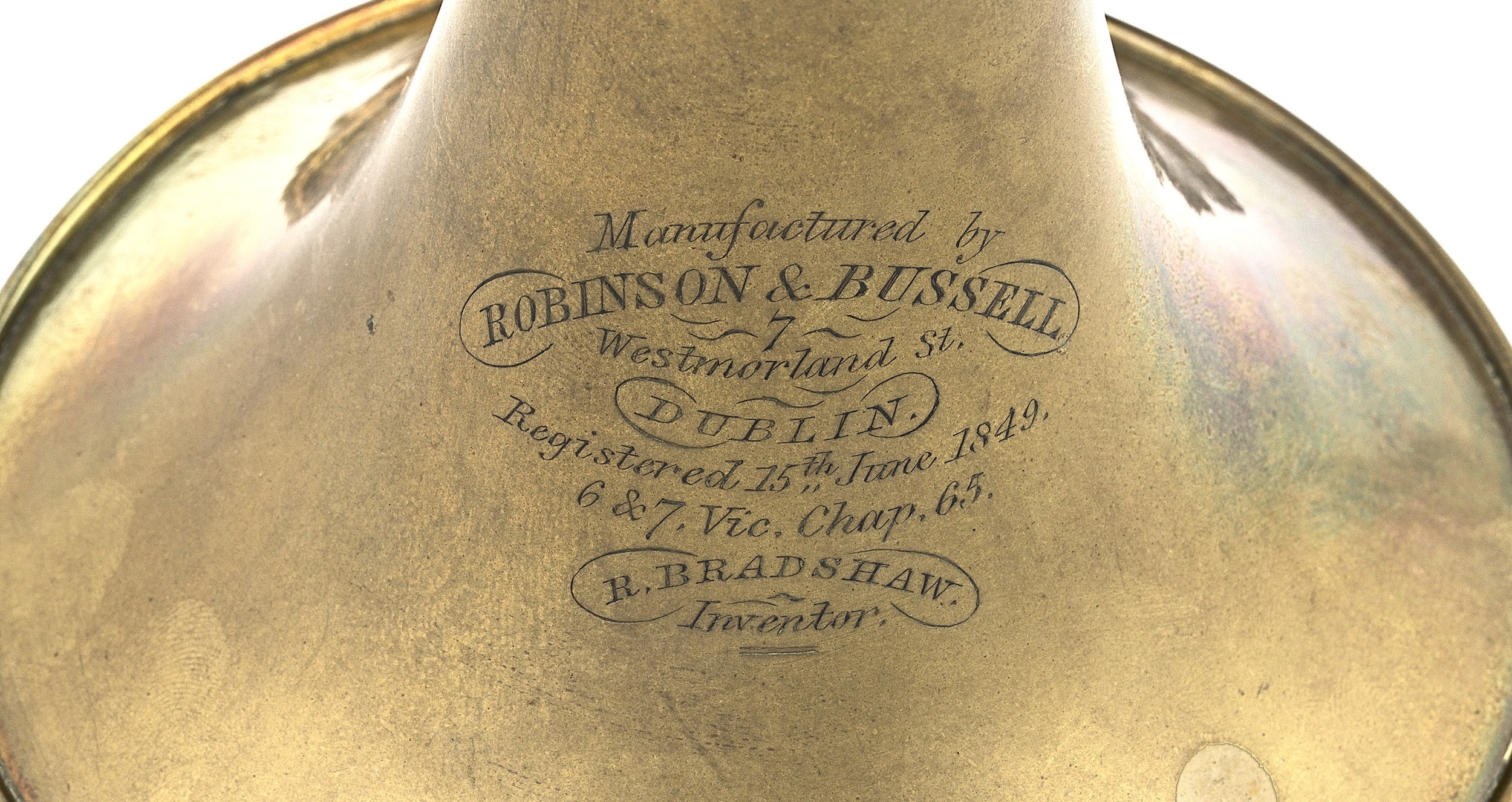
The last of Bradshaw’s three designs was registered on June 15, 1849, again by Robinson and Bussell. And again, they attribute the invention to Robert Bradshaw. This instrument, currently on loan by Arnold Myers to the University of Edinburgh Musical Instruments Museums (accession number 5734), had belonged to the late John Webb, who wrote a short article published in The Galpin Society Journal XXXV, March, 1982. Webb described the instrument and presented the results of his research. He stated that the only other of this design that he had seen was in advertisements, illustrated below, in the Musical Times, starting in January, 1850. This claim is made in the ad: “…avoiding the bends and turns hitherto found in ‘Sax Valve,’ and other Instruments…this Cornopean alone possesses the property of giving (without turns) a direct passage to the wind in producing a valve note. It is constructed on the principle of the Trombone, which in forming the note admits the wind (without its being driven to either side through contracted angles) through straight tubes.” These statements are misleading, since the “wind” travels through curves in the valves that are very similar to “Sax Valves” (today, we call these “Berliner valves”). The straight tubes that pass through the valve casings in a seemingly straight route are in reality external covers that hide the curved tubes that enter and exit the casings. Internally, the valves are the same as in the “British Valve Cornopean”. The claims that could rightly be made are that the bore is not restricted through the pistons and that the curves in the tubing are roughly the same in the open position as for when the valves are depressed. Perhaps they considered this explanation too complicated for the audience which the ad was intended.
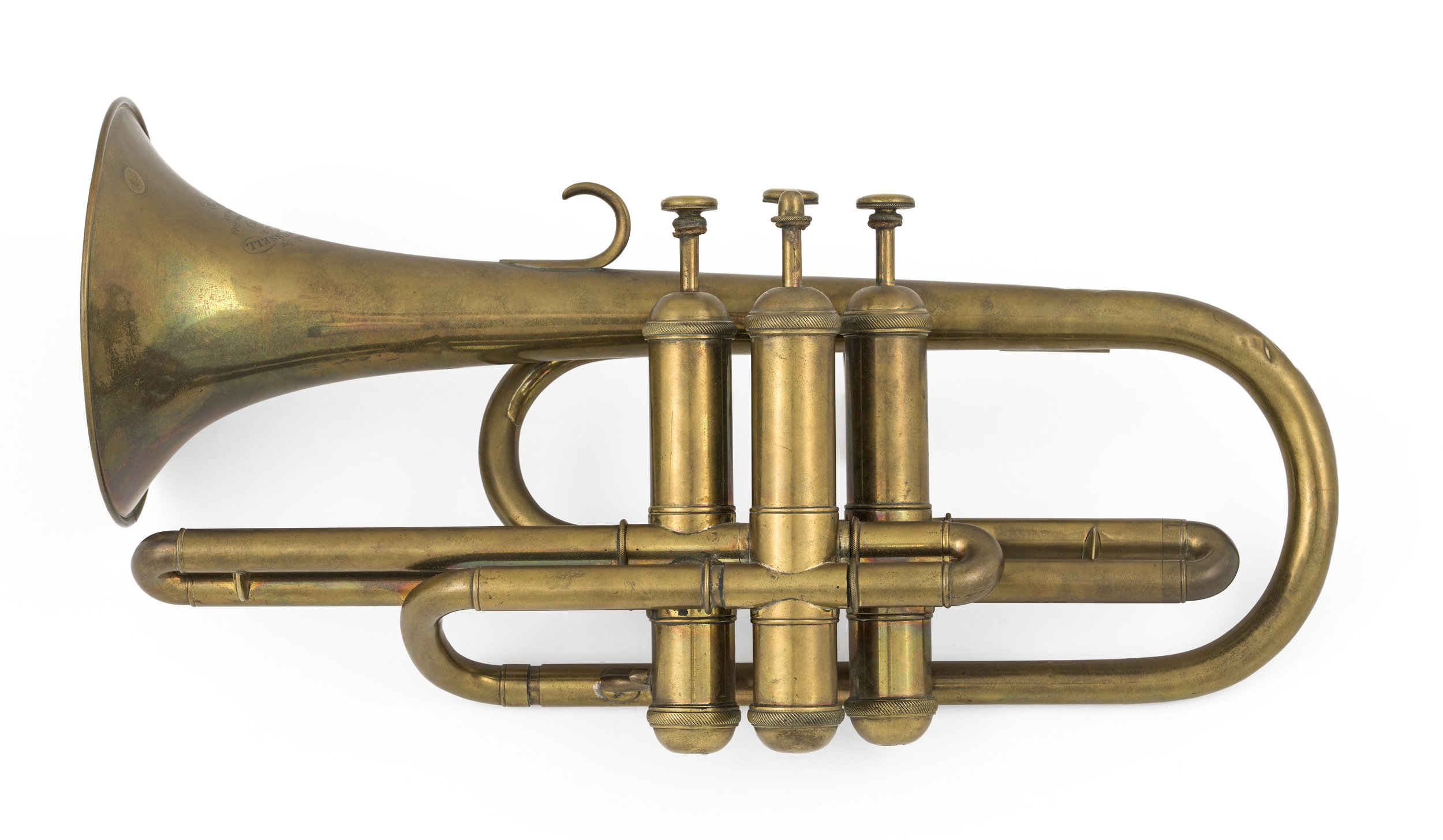
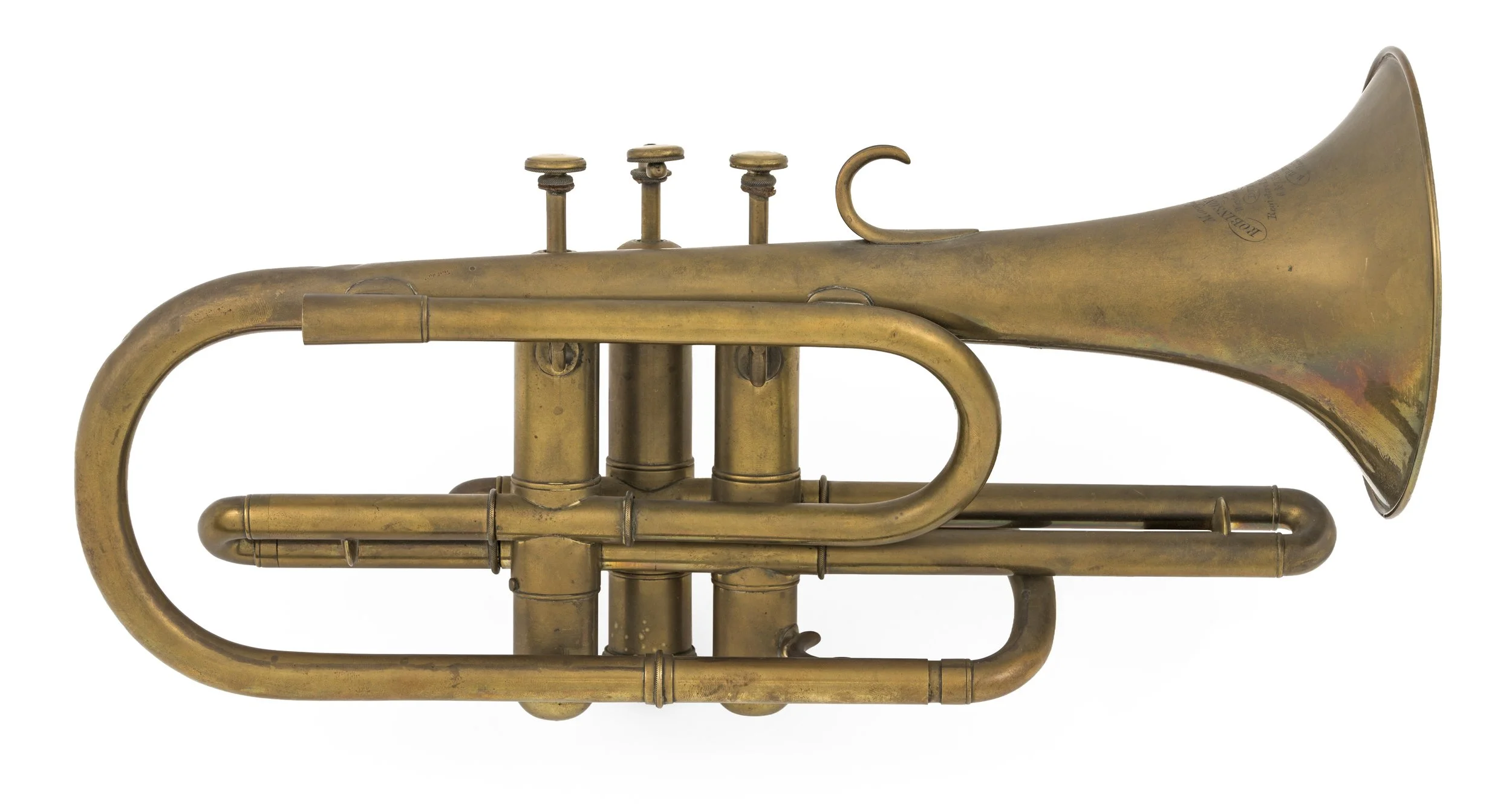
To reinforce the visual concept of “direct passage”, the routing of the tubing was changed from the two previous designs. The mouth-pipe tube entered the first valve rather than the second, In addition, the second valve was offset from the other two, allowing a straight tube to connect the first valve to the third. By eliminating the curved tubing connecting the first valve to the second and the third valve to the tuning slide, the new design allowed for longer bell and mouth-pipe tubes. This seems another advantage that wasn’t mentioned in the registered design or the advertisement.
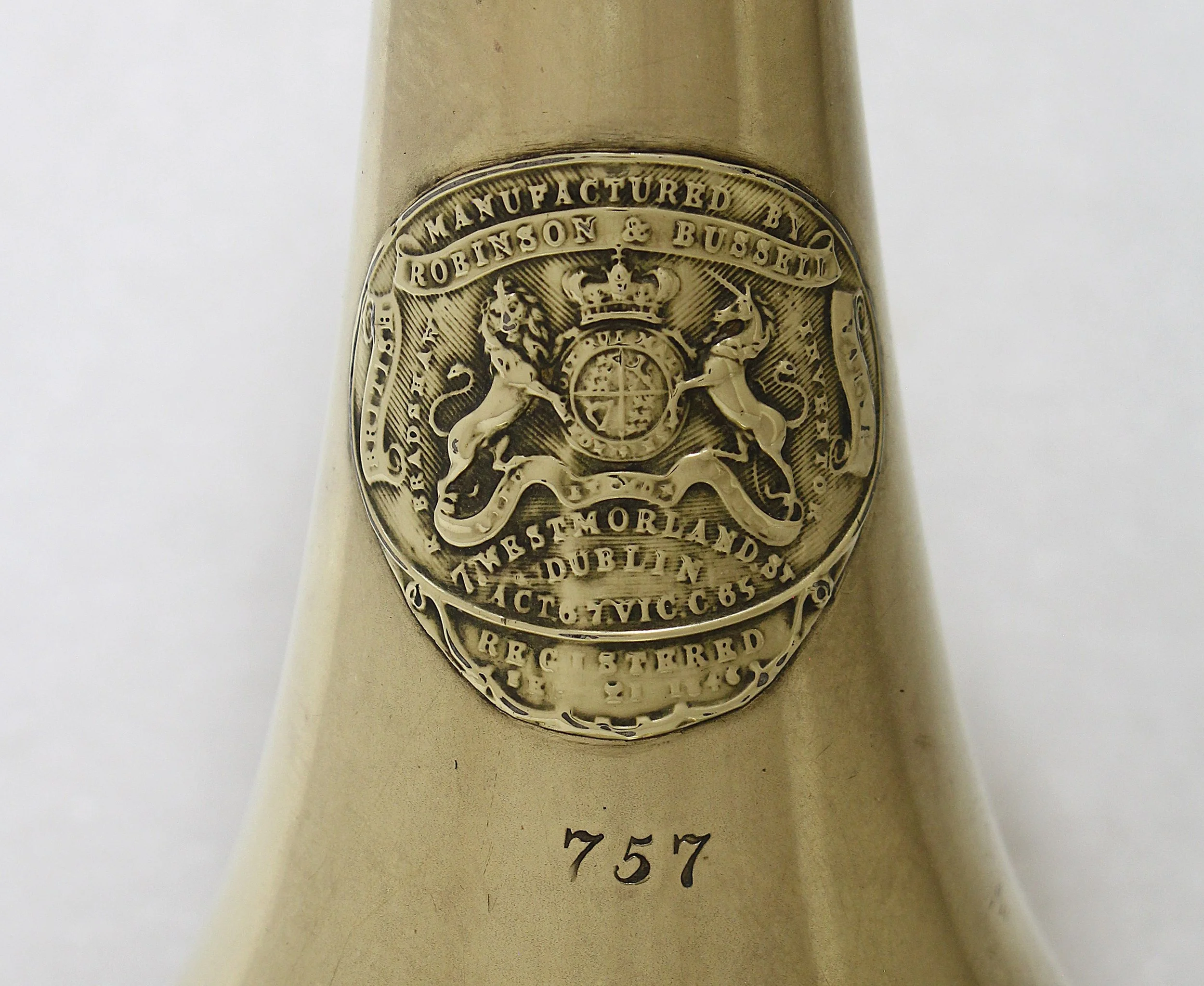
The last of these three cornets has no serial number. The 1945 Bradshaw Albert Valve Cornopean has a number, 14. The Robinson and Bussell British Valve Cornopean has a number 757. But there is no number on the Serpentine Valve Cornopean. The number “757” seems like a high number assuming that all instruments produced since “14” were sequential, but like so much of this story, we use our reason, based on history and knowledge of the industry.
Bradshaw entered a cornet of this design and two brass models of paddle wheels in the Exhibition of Arts and Manufactures of the Royal Dublin Society, held in July, 1850. For the cornet, he was awarded a certificate. The report of the judges indicates that certificates were awarded to patented designs that “appeared to them to possess merit in their principal, as well as perfection and accuracy in their execution.”
The Musical Times advertisement illustrated above also states that this valve design “…has been applied to the Trumpet, E, D and Bb Alto Horn, Trombone, Ophicleide and Bombardone…” This may be another claim without merit, but leaves hope that another example of this valve design may have survived.
Henry Bussell advertised in the Freeman’s Journal, January 27, 1854, the availability of “Cornopeans, with Patent Revolving Valves (by R. Bradshaw…constructed without angular passages…)”. Perhaps there is a fourth Bradshaw design yet to be found.



In all three of the cornets featured here, there is no taper or other change in tubing bore from the end of the mouthpiece to the start of the bell tube. This was the practice of English makers of cornopeans from their origins in the mid-1830s, including Pace, Kohler, Keat, Percival and others, as well as German made copies for the British market. This was in contrast to the French cornets à pistons, which were developed as small horns, as the name indicates. From the start, the latter had very small mouthpiece shanks that fit into mouth-pipe tubes with tapers similar to the larger horns.
It may be only tangential, but some of the earliest English cornopeans were made in London by Charles and Frederick Pace, whose father began his brass instrument making career making keyed bugles in Dublin. If there is a direct connection to Logier and Ellard, it was two decades before the first valve instruments were made in either city. No examples of cornopeans by Ellard or by Robinson, Bussell and Robinson as presented in the 1838 advertisement are known for examination. If they were indeed British or German made, they were very likely more like the early Pace cornopeans than the French cornets-à-pistons.
While there has been some study of the music business in Ireland in the 18th and 19th century, there is much to be learned. This is especially true with the story of the makers of instruments for military bands and brass instruments specifically.